West Bengal Voter Roll Deletions Spark Political Row


West Bengal Chief Minister Mamata Banerjee has accused the Election Commission of India of working in tandem with the Bharatiya Janata Party over large-scale deletions in the state’s revised electoral rolls, days after the publication of the updated list.
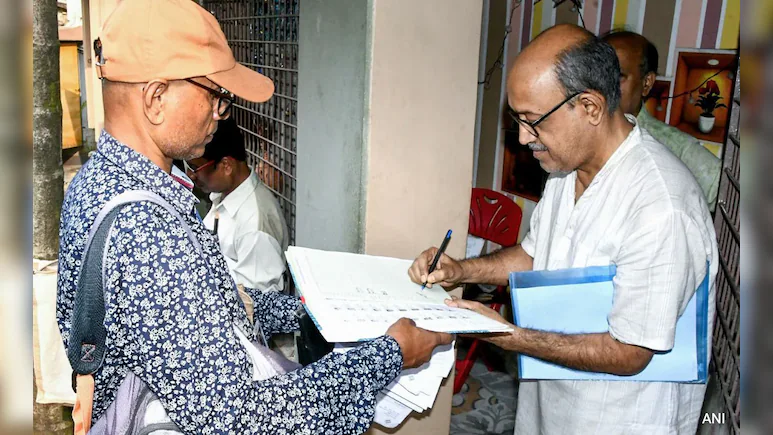
The controversy follows the release of West Bengal’s post–Special Intensive Revision voter rolls on 28 February, which recorded 63.66 lakh deletions, amounting to about 8.3% of the electorate. The revision has reduced the total number of registered voters in the state to just over 7.04 crore, according to official data.
Allegations of a “nexus”
Ms Banerjee, who heads the Trinamool Congress party, described the deletions as deliberate and politically motivated. She alleged a “nexus” between the Election Commission of India and the Bharatiya Janata Party, which governs at the federal level.
“The Election Commission has deliberately deleted genuine voters. I am shocked. This is a very sad and inhumane state of affairs,” she said at a public event in Kolkata.
Assembly elections in West Bengal are expected in April, heightening political sensitivities around the voter list revision.
Ms Banerjee claimed that even her own constituency of Bhabanipur had seen extensive deletions. “Despite massive deletions in my Bhabanipur constituency, I will win even if there is one voter left,” she said.
She further alleged that the Bharatiya Janata Party was resorting to voter removals because it could not secure victory on its own. The Chief Minister announced plans to stage a protest from 6 March, saying she would hold a sit-in demonstration against what she termed the “nexus” between the poll body and the ruling party at the Centre.
Under adjudication category
In addition to deletions, more than 60.06 lakh names — about 8.5% of the electorate — have been placed in an “under adjudication” category. These cases are subject to further scrutiny in the coming weeks.
The Special Intensive Revision, a periodic exercise carried out by the Election Commission to update voter rolls, is being described by officials as the most extensive revision in West Bengal since 2002.
Several prominent figures have found their names in the adjudication list, intensifying the political dispute.
Among them are state minister Ghulam Rabbani, cabinet minister Shashi Panja, multiple legislators from the Trinamool Congress, and West Bengal’s Chief Secretary Nandini Chakraborty.
Mr Rabbani, who serves as minister for environment and non-conventional energy, said he had contested four state elections and had been voting regularly for decades. In a social media post, he described the move as “an unprecedented ugly move by Election Commission”, alleging political interference.
Zakir Hussain, a two-time Trinamool Congress legislator from Jangipur, told reporters that he had provided all required documentation during the hearing process but remained under adjudication. “If an MLA could be harassed thus, the Election Commission could harass common people even more easily,” he said, adding that he had faith in the judiciary.
Shashi Panja, another minister whose name appears under adjudication, said she found the situation “baffling and insulting”. She noted that while her family members’ names were included in the rolls, hers had been flagged for further scrutiny.
The Trinamool Congress has also claimed that Richa Ghosh, a 22-year-old cricketer from Siliguri and a member of India’s 2025 Women’s Cricket World Cup-winning team, was placed in the adjudication category. The party described the move as humiliating and questioned the basis for such scrutiny.
Opposition response
The Bharatiya Janata Party has rejected allegations of wrongdoing. Suvendu Adhikari, the Leader of the Opposition in the West Bengal Legislative Assembly, said that cases under adjudication would be examined through due legal processes.
He stated that the review was intended to determine citizenship status where required and added that, in his party’s view, individuals residing illegally in the state should not be included in the electoral rolls.
The Election Commission of India has not publicly responded to the specific allegations made by Ms Banerjee and members of her party. The Commission has previously stated that voter roll revisions are conducted to ensure accuracy and remove ineligible or duplicate entries, in line with electoral laws.
Political implications
The publication of the revised rolls has triggered widespread debate in West Bengal, a politically significant state of more than 100 million people. Electoral rolls determine who is eligible to vote and are considered central to the integrity of democratic processes.
The scale of deletions and the large number of cases under adjudication have raised concerns among opposition parties, who argue that genuine voters may be at risk of exclusion ahead of the assembly elections.
Supporters of the revision say periodic scrutiny is necessary to maintain accurate records, particularly in border states where migration is a sensitive issue.
With elections approaching, the dispute over voter rolls is likely to remain a key political issue in the state. Whether the adjudication process will restore or permanently remove the contested names may have implications for public confidence in the electoral system.
The coming weeks are expected to see further legal and political challenges as parties prepare for the polls.
Kerala Initiates Probe into 2006 Suicide Case Involving CEC
Extradition of Sheikh Hasina Feasible, Says Indian High Commissioner

Punjabi Makeup Artist Mad Sandhu Shot Dead in Amritsar
India Achieves Fourth Place at Asian Games 2026 Through Late Success