Israel–Iran Conflict: Indian Leaders Clash Over Response


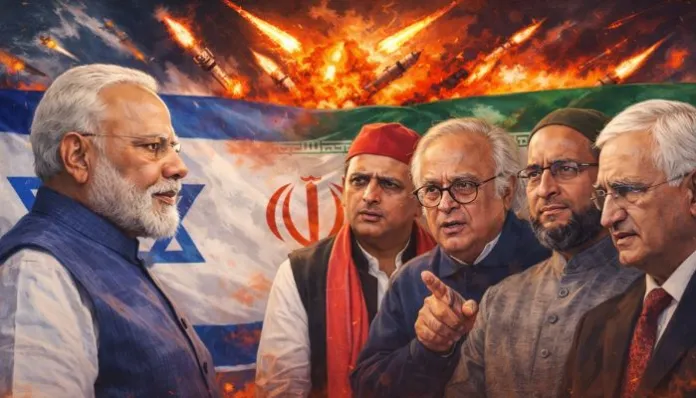
India’s political leaders have expressed sharply differing views after reported Israeli and United States strikes on Iran, followed by retaliatory missile launches, escalating tensions across West Asia.
Asaduddin Owaisi, president of the All India Majlis-e-Ittehadul Muslimeen and a member of India’s lower house of parliament, condemned the reported killing of Iran’s Supreme Leader, Ayatollah Ali Khamenei, describing it as “immoral and unlawful”. He also criticised military action by Israel and the United States, warning of wider regional instability.
Escalation in West Asia
The latest crisis began after Israel and the United States launched coordinated strikes on targets in Iran on 28 February, according to multiple reports. Iran subsequently responded with missile attacks aimed at Israel and at several United States military facilities in the region.
The developments have heightened tensions in a region already facing prolonged instability, including conflict in Gaza and strained relations between Iran and Western powers over Tehran’s nuclear programme.
Iran and the United States had been engaged in diplomatic talks in Geneva prior to the reported escalation. The precise status of those discussions remains unclear.
Owaisi condemns attacks
Speaking to reporters in Hyderabad on Sunday, Mr Owaisi said the killing of Ayatollah Khamenei, if confirmed, was unlawful under international norms. “The attacks are absolutely condemnable, especially when Iran-US talks were going on in Geneva,” he said.
He added that more than 200 people had been killed in the strikes on Iran, including students reportedly killed when a girls’ school was hit. The casualty figures have not been independently verified.
“These attacks on Iran should stop at the earliest, otherwise the whole region will be embroiled in instability,” Mr Owaisi said.
He also called on the government of Indian Prime Minister Narendra Modi to condemn what he described as an assassination and to work diplomatically to end the conflict. Mr Owaisi noted that millions of Indian nationals live and work in Gulf countries and could be affected by prolonged hostilities.
“We must remember that 10 million Indians work in Gulf countries,” he said, adding that some Indian pilgrims travelling for Umrah were reportedly stranded due to flight cancellations.
India’s diplomatic balancing act
India has longstanding ties with both Israel and Iran.
Israel is one of India’s key defence partners, supplying advanced military equipment and cooperating in areas such as intelligence and agriculture. At the same time, India has maintained strategic links with Iran, including investments in the Chabahar port, which New Delhi views as vital for trade access to Afghanistan and Central Asia.
The government has not issued a detailed public statement on the latest developments, but India has historically called for restraint and dialogue during crises in West Asia.
Opposition criticism
The escalation has also triggered domestic political debate.
Some opposition leaders questioned the timing of Prime Minister Modi’s recent diplomatic engagements with Israel, suggesting that India must clarify its position amid the conflict. They argued that New Delhi should articulate a clear stance consistent with its traditional policy of non-alignment, now often described as “strategic autonomy”.
India’s foreign policy has evolved significantly since the Cold War era. Rather than aligning exclusively with any bloc, New Delhi has sought to cultivate relationships with multiple powers, including the United States, Russia, Israel and Iran.
Analysts say this approach allows India to protect its economic and security interests while avoiding direct involvement in regional rivalries.
Regional implications
The current escalation raises concerns about broader instability across West Asia, home to large expatriate communities from South Asia.
Millions of Indian citizens live and work in countries such as Saudi Arabia, the United Arab Emirates and Qatar, sending significant remittances back to India each year. Any sustained conflict that disrupts air travel, trade routes or regional security could have economic and humanitarian consequences.
The situation also risks complicating global energy markets. India is heavily dependent on imported crude oil, much of which originates in or passes through the Gulf region.
Wider context
Tensions between Israel and Iran have simmered for years, marked by covert operations, cyber incidents and proxy confrontations in countries such as Syria and Lebanon. The United States has long accused Iran of destabilising the region, while Tehran has criticised American military presence and sanctions.
Previous diplomatic efforts to limit Iran’s nuclear activities have faced setbacks, particularly after the United States withdrew from the 2015 nuclear agreement during the presidency of Donald Trump.
With the latest exchange of strikes, regional and international actors are urging de-escalation to prevent a broader war.
For India, the challenge lies in safeguarding its national interests while maintaining working relationships with competing powers. As the crisis unfolds, New Delhi is likely to continue advocating dialogue and restraint, even as domestic political debate over its approach intensifies.
Kerala Initiates Probe into 2006 Suicide Case Involving CEC
Extradition of Sheikh Hasina Feasible, Says Indian High Commissioner

Punjabi Makeup Artist Mad Sandhu Shot Dead in Amritsar
India Achieves Fourth Place at Asian Games 2026 Through Late Success