Director Lakshmipriya Devi Rejects ‘Northeastern’ Label


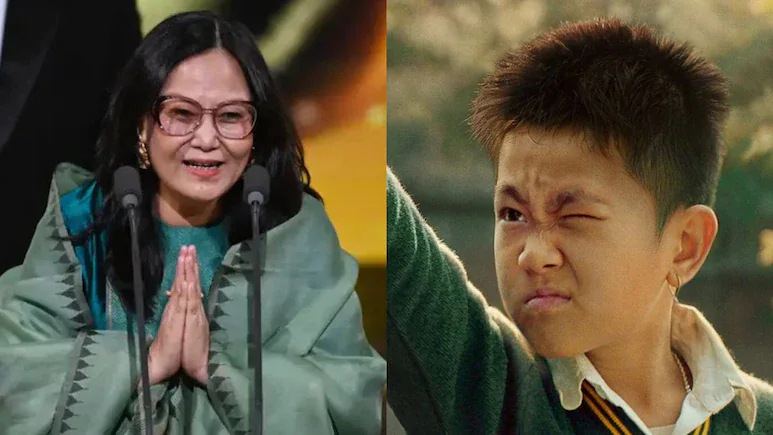
Indian filmmaker Lakshmipriya Devi has spoken about being labelled a “Northeastern filmmaker” after her film Boong became the first Indian movie to win an award at the British Academy Film Awards (BAFTA) in 2026.
The director addressed the issue during a press conference held shortly before the film’s theatrical release, reflecting on how her background and gender have often shaped how others describe her work.
Historic recognition at the BAFTA awards
Boong has drawn international attention after receiving recognition at the British Academy Film Awards, one of the world’s most prominent film honours.
The film, written and directed by Lakshmipriya Devi, first premiered at the Toronto International Film Festival before continuing its run across several international film festivals.
Its recognition at BAFTA has been described by industry observers as a milestone for Indian cinema, particularly for filmmakers working outside the country’s mainstream film industries.
During the press interaction, Devi spoke about the attention the film has received and the way her identity has often been framed in public discussions.
Responding to labels in the film industry
Lakshmipriya Devi said she has frequently been categorised according to her background rather than simply as a filmmaker.
“There have been too many boxes that I have been put into, from coming from the Northeast to being a woman. It becomes too many things. But I was never looking at myself like that,” she said while discussing her experience in the industry.
India’s northeastern region consists of eight states, including Manipur, where Devi grew up. The region has historically been underrepresented in the country’s mainstream film sector.
The director explained that while her upbringing influences her perspective, she does not see it as a defining label for her work.
Influence of Manipur on her worldview
Lakshmipriya Devi said that growing up in the northeastern state of Manipur helped shape her outlook, particularly regarding the role of women in society.
She remarked that women in her home state are often seen as strong and influential figures in community life.
“Particularly having come from Manipur, women are very strong, so you particularly feel very bad for men there,” she said with a laugh during the press conference.
Her comments highlight the cultural context of the region, where women have traditionally played significant roles in markets, activism and social life.
From large productions to independent storytelling
Before directing Boong, Devi worked on the sets of several large-scale Indian film productions.
These include Hindi-language films such as Dunki, Talaash, Rang De Basanti and PK, which were produced within India’s mainstream cinema industry.
She explained that making Boong presented a different kind of challenge compared with working on large productions.
According to Devi, the greatest difficulty was not logistical but creative, as the film required her to confront her own ideas and storytelling instincts.
Story and themes of Boong
Boong is set in the northeastern Indian state of Manipur and centres on a young schoolboy searching for his missing father.
The child lives with his mother, who struggles to cope with the uncertainty surrounding her husband’s disappearance after he left for work in the border town of Moreh.
When documents arrive claiming that the father has died, the family refuses to accept the information without proof.
The story follows the boy as he attempts to locate his father, travelling toward the border region and confronting unexpected challenges along the way.
The narrative also explores themes such as migration, family relationships and identity.
Some scenes take place in areas near the border between India and Myanmar, reflecting the geographic and cultural complexities of the region.
Critical reception and themes
Film critics have described Boong as a moving story about determination, family bonds and hope.
The film combines humour with emotional storytelling, focusing on the perspective of a child navigating circumstances that even adults might find difficult.
It also touches on broader issues affecting the region, including social tensions and questions of belonging.
The narrative introduces several supporting characters who assist the young protagonist during his journey, highlighting themes of friendship and resilience.
Context: representation in Indian cinema
The success of Boong at the BAFTA awards has renewed discussions about representation within Indian cinema.
While India produces one of the largest numbers of films in the world each year, most internationally known productions originate from major industries such as Hindi-language Bollywood or the southern regional film sectors.
Filmmakers from the northeastern states have historically received less visibility, despite the region’s distinct cultures and storytelling traditions.
Industry observers say the recognition of Boong could encourage greater attention to stories emerging from different parts of India.
Lakshmipriya Devi’s remarks also reflect a broader conversation within global cinema about how filmmakers are identified by gender, geography or cultural background.
For Devi, however, the focus remains on storytelling itself.
As her comments suggest, she prefers to be seen primarily as a filmmaker rather than defined by labels linked to her origins.

US Space Force confirms weapons deployed in space orbit

Maruti Suzuki Exports One Lakh Units of Jimny and Fronx to Japan

China's Foreign Minister Urges Strengthening International Ties

BJP Maintains Position Despite Strong Performance by Independents in Rajasthan