Starmer Breaks with Trump Over Iran Strikes


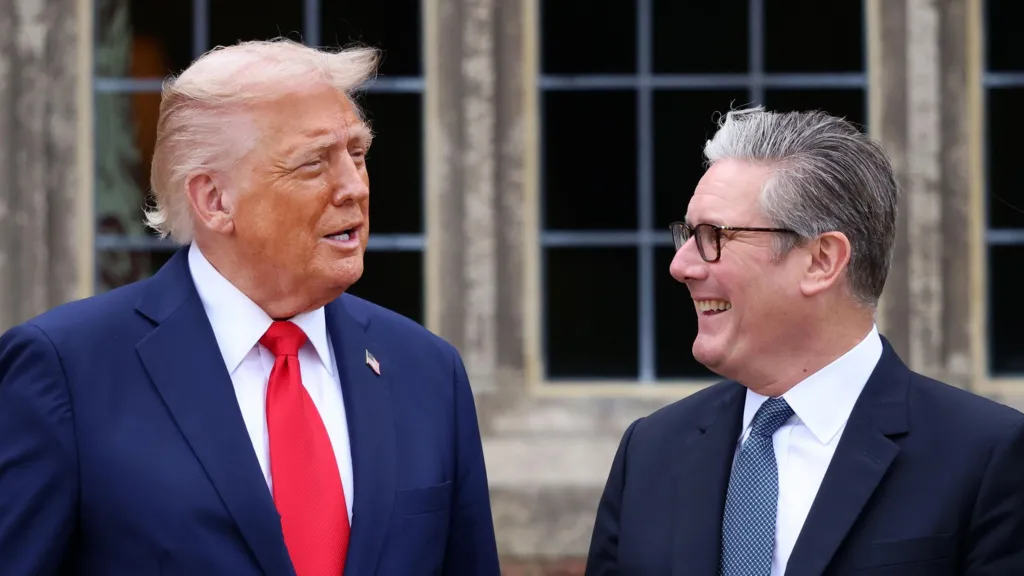
UK Prime Minister Sir Keir Starmer has openly disagreed with United States President Donald Trump over the US-Israeli military strikes on Iran, saying Britain does not support “regime change from the skies” and will not join offensive operations.
Addressing Parliament, Sir Keir said the United Kingdom had not participated in the initial strikes and would act only in accordance with international law and Britain’s national interest.
Clear split with Washington
The prime minister acknowledged that President Trump had expressed disappointment with London’s refusal to take part in the early stages of the military campaign.
“President Trump has expressed his disagreement with our decision not to get involved in the initial strikes,” Sir Keir told Members of Parliament. “But it is my duty to judge what is in Britain’s national interest. That is what I’ve done, and I stand by it.”
He added: “This government does not believe in regime change from the skies,” signalling a fundamental difference in approach between London and Washington.
President Trump had earlier criticised Britain for what he described as delays in allowing US forces access to British military facilities. He later confirmed that US aircraft were operating from Diego Garcia, a joint UK-US military base in the Indian Ocean, but repeated that he was “very disappointed” with the British position.
Defensive support but no offensive role
Although the UK declined to join offensive strikes, it has authorised limited use of British bases for defensive purposes. Sir Keir said this decision was taken after Iranian missile and drone attacks threatened British nationals and facilities in the Gulf region.
“We were not involved in the initial strikes against Iran, and we will not join offensive action now,” he said. “But in the face of Iran’s barrage of missiles and drones, we will protect our people in the region.”
Approximately 300,000 British nationals live across the Middle East. UK officials said that enabling defensive operations was necessary to help shield allies and British citizens from further attacks.
On Sunday, an Iranian-made drone struck Royal Air Force Akrotiri in Cyprus, causing limited damage but no casualties, according to officials.
Legal considerations and Iraq legacy
Sir Keir repeatedly referred to the 2003 Iraq war during a lengthy parliamentary session, underscoring the importance of legality in decisions about military intervention.
“We all remember the mistakes of Iraq, and we have learned those lessons,” he said. “Any UK actions must always have a lawful basis, and a viable, thought through plan.”
The prime minister, a former senior lawyer, suggested that while there are differing legal interpretations, his government believes the US-Israeli action does not meet the threshold required under international law.
The Conservative opposition and Reform UK have argued that Britain should have expressed clearer support for its allies. By contrast, the Liberal Democrats, the Green Party and the Scottish National Party have been more critical of President Trump’s strategy.
An opinion poll by YouGov indicated that more people in Britain oppose the US action than support it, and that a similar proportion disapprove of allowing US forces to use British airbases.
Escalating regional crisis
The military escalation has widened across the Middle East. Iranian state media reported hundreds of deaths since the strikes began, including senior figures. The United States military has confirmed casualties among its forces.
Iran has launched missiles and drones at targets across the region, and tensions remain high in Gulf states where US and allied forces are stationed.
Sir Keir warned that further escalation could worsen instability. “It is very clear that the death of the Supreme Leader will not stop Iran from launching these strikes,” he said. “In fact, their approach is becoming even more reckless and more dangerous to civilians.”
Economic uncertainty
The diplomatic rift comes as Chancellor Rachel Reeves prepares to deliver her Spring Statement. Although officials have described it as a routine fiscal update rather than a major budget event, the government faces renewed economic uncertainty stemming from the international crisis.
The Office for Budget Responsibility is expected to present updated forecasts, with ministers emphasising economic stability and efforts to reduce borrowing and debt.
The broader economic consequences of the conflict, including energy market volatility and potential trade disruption, are still unfolding.
A defining foreign policy moment
For Sir Keir, the disagreement with President Trump represents one of the most consequential foreign policy moments of his premiership so far.
Balancing support for long-standing allies with adherence to international law and domestic political sentiment has placed the government in a delicate position.
As the conflict continues and diplomatic tensions rise, Britain’s stance underscores the challenges faced by European governments navigating relations with Washington during a period of heightened global instability.
Kerala Initiates Probe into 2006 Suicide Case Involving CEC

Extradition of Sheikh Hasina Feasible, Says Indian High Commissioner

Punjabi Makeup Artist Mad Sandhu Shot Dead in Amritsar

India Achieves Fourth Place at Asian Games 2026 Through Late Success