Iran’s New Supreme Leader Vows to Keep Strait of Hormuz Closed


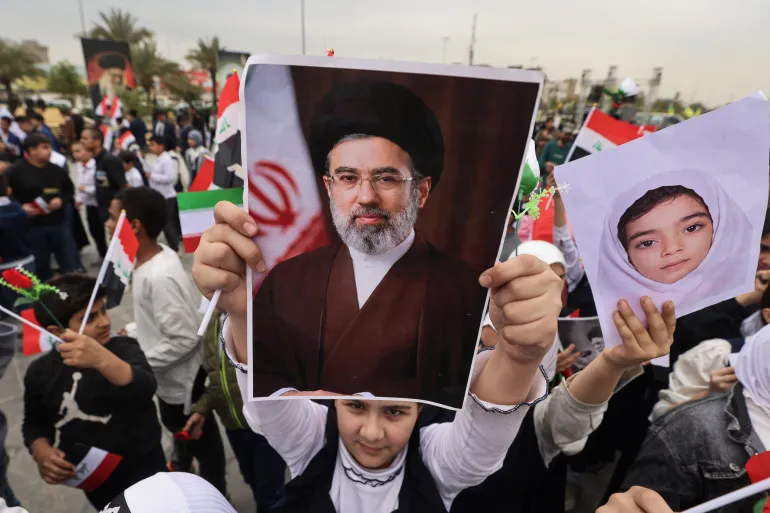
Iran’s new Supreme Leader Mojtaba Khamenei has issued his first public statement since assuming power, declaring that Iran will continue fighting and maintain the closure of the Strait of Hormuz amid the ongoing war involving the United States and Israel.
The remarks, broadcast on Iranian state television, come weeks after the death of former Supreme Leader Ayatollah Ali Khamenei in strikes linked to the conflict that has spread across parts of the Middle East.
New leader adopts defiant tone
In his first statement since assuming the country’s highest authority, Mojtaba Khamenei urged national unity while signalling that Iran would maintain a confrontational stance against its adversaries.
The message, read on Iran’s state broadcaster Press TV, said Tehran would continue to block the Strait of Hormuz, a crucial shipping lane through which a large share of global oil supplies normally passes.
“The lever of blocking the Strait of Hormuz must continue to be used,” the statement said, according to Iranian state media.
Khamenei also warned that United States military bases in the region should be shut down or face attacks.
He said Iran’s military campaign would continue while expressing gratitude to Iranian armed forces for resisting external pressure.
“I would like to thank the brave fighters who are doing a great job at a time when our country is under pressure and under attack,” he said.
Succession after assassination of former leader
The statement marks the first public remarks attributed to Mojtaba Khamenei since he was appointed supreme leader by Iran’s Assembly of Experts.
He succeeded his father, Ayatollah Ali Khamenei, who had led Iran for nearly four decades before being killed in Tehran during the opening phase of the conflict.
Iranian officials said members of the former leader’s family were also killed in the strikes.
The Assembly of Experts, a powerful clerical body responsible for selecting the country’s supreme leader, reached a consensus earlier this week to appoint Mojtaba Khamenei as his successor.
The new leader’s statement was read out on state television rather than delivered in person, and no recent images of him have been publicly released since the attacks.
Iranian authorities have previously said he suffered minor injuries during the strikes.
Attacks at sea and rising tensions
The statement coincided with escalating maritime attacks in the region.
Two oil tankers were reported to be on fire in an Iraqi port following attacks believed to involve explosive-laden boats, according to officials cited by Reuters.
Footage verified by journalists showed large fires engulfing ships near the southern Iraqi port of Basra.
Earlier the same day, several other vessels reported being struck by projectiles in the Gulf region.
Iran’s Revolutionary Guards said at least one of the attacks targeted a Thai bulk carrier that had allegedly ignored their orders.
The incidents underline the growing risks to shipping in the region as hostilities intensify.
The Strait of Hormuz, located between Iran and Oman, is one of the world’s most important maritime routes for oil and gas shipments.
Analysts estimate that roughly one fifth of globally traded crude oil normally passes through the narrow waterway.
Global energy disruption
The conflict has already caused significant disruption to global energy markets.
The International Energy Agency, which monitors global energy supply trends, described the crisis as potentially the largest disruption to oil supplies in modern history.
Oil prices have climbed above 100 US dollars per barrel as markets respond to fears of prolonged supply interruptions.
Iranian officials have indicated that keeping the strait closed is part of a broader strategy to exert economic pressure on countries supporting military action against Iran.
A spokesperson for Iran’s military command said earlier that global markets could face oil prices as high as 200 dollars per barrel if the disruption continues.
The United States and other developed economies have attempted to stabilise markets by announcing plans to release oil from strategic reserves.
Officials say around 400 million barrels could be released from emergency stockpiles, with nearly half expected to come from the United States.
However, analysts note that releasing these reserves could take months and may only offset a limited portion of the disrupted supply.
Regional escalation
The wider conflict continues to expand across the Middle East.
Reports indicate that armed groups aligned with Iran in several countries have intensified attacks on Israeli and United States targets.
Lebanon’s Hezbollah movement reportedly launched a large volley of rockets into Israel, prompting further Israeli air strikes in Beirut.
Meanwhile, drones were reported flying into several Gulf countries including Kuwait, Bahrain and Oman.
Inside Iran, residents say security forces have increased their presence in cities as authorities seek to maintain control during wartime conditions.
Some residents told reporters that daily life continues with shops and supermarkets open, though many people remain cautious about leaving their homes.
Political reactions and uncertainty
International analysts say the tone of Mojtaba Khamenei’s statement suggests continuity with Iran’s previous leadership rather than a shift toward de-escalation.
Rob Geist Pinfold, a lecturer in international security at King’s College London, said the remarks reinforced Iran’s longstanding strategic posture.
“Rather than what the Trump administration might have been hoping for – a kind of change in rhetoric from the new supreme leader – what we’re actually hearing here is more of the same,” he said.
Other analysts noted that the speech focused heavily on military resistance rather than domestic issues such as economic reform.
The statement also appeared to contrast with remarks made earlier by Iranian President Masoud Pezeshkian, who had suggested that Iran might consider ending the conflict if certain conditions were met.
Context: Strait of Hormuz at the centre of global energy trade
The Strait of Hormuz remains a critical choke point for global energy markets.
Every day, tens of millions of barrels of oil move through the narrow passage connecting the Persian Gulf to the Arabian Sea.
Any prolonged disruption in the area has the potential to affect fuel prices, shipping routes and economic stability worldwide.
Iran’s decision to maintain pressure on the strait signals that energy markets may continue facing uncertainty as the conflict unfolds.
Kerala Initiates Probe into 2006 Suicide Case Involving CEC
Extradition of Sheikh Hasina Feasible, Says Indian High Commissioner

Punjabi Makeup Artist Mad Sandhu Shot Dead in Amritsar

India Achieves Fourth Place at Asian Games 2026 Through Late Success