Iran's Attack on US Base in Bahrain Triggers Strategic Review


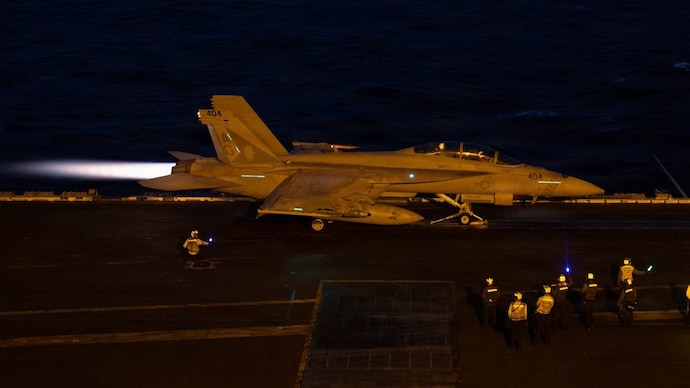
The recent missile and drone attacks by Iran on the US Naval Support Activity (NSA) in Bahrain have unveiled significant implications beyond immediate infrastructure damage. An investigation by The Wall Street Journal reveals that these attacks have led to extensive impairment of vital military facilities at the base, prompting a critical evaluation by US military officials regarding their long-term strategy in the region. This evaluation comes in the wake of consecutive strikes between late February and June, believed to have inflicted more damage than what has been publicly disclosed by the Pentagon.
Satellite images, social media content, and interviews with current and former US service members provide evidence of the attacks' severity. Strategic locations within NSA Bahrain, including the command headquarters and vital communications terminals, were compromised. While the US military reported no casualties among personnel and stated operations continued with minimal disruption, a significant number of military staff had already been evacuated prior to the major assaults.
Captain Tim Hawkins, a spokesperson for US Central Command, defended the military’s approach. "Centcom rightfully prioritised the protection of people over buildings, and our strategy of protecting people worked," Hawkins stated, highlighting that more than 8,000 Iranian missiles and drones were launched during this period, resulting in only two US fatalities. He further pointed out that US forces had successfully targeted over 13,500 locations in Iran as part of their operations.
The attacks underscore challenges confronting US military installations designed before the advent of Iran's advanced precision munitions. As military analysts observe, the recent strikes raise urgent questions about the viability of US bases in the Gulf amid evolving military threats. Potential actions being explored include fortifying existing bases, relocating or reducing their size, and potentially shifting command operations further west. Additionally, military planners are considering the distribution of capabilities across multiple smaller locations, rather than concentrating them in a few large bases.
Israel has emerged as a potential site for accommodating expanded US military assets, following its assistance in hosting numerous American aircraft during the hostilities. Despite military revisions on the table, final decisions have yet to be confirmed.
The financial ramifications of the missile attacks are still being assessed. The Pentagon has refrained from providing a complete cost analysis of damages caused during the conflict. When queried by lawmakers regarding these costs, US Defence Secretary Pete Hegseth noted, "What is the cost of Iran obtaining a nuclear weapon?" The Pentagon later clarified that an estimated $29 billion in total war costs did not include specific base damage assessments. The Center for Strategic and International Studies (CSIS) has suggested that overall conflict expenses could be around $40 billion, estimating that damage to US bases stands between $2.2 billion and $5.1 billion.
Financial estimates indicate that rebuilding NSA Bahrain alone could amount to approximately $400 million, not accounting for specialized military equipment and security upgrades. Notably, two destroyed satellite communications terminals were valued at $20 million each, as per CSIS reports.
Since NSA Bahrain also functioned as a residential community for military families, the attacks have significantly impacted personnel morale and operational capabilities. US Secretary of State Marco Rubio recently visited Bahrain’s King Hamad bin Isa Al Khalifa and other Gulf leaders this week, reaffirming Washington's dedication to regional stability. However, his visit notably excluded Saudi Arabia, which has limited US military access during the ongoing conflict.
In previous years, proposals were made during President Donald Trump’s administration to displace certain US military assets to mitigate risks posed by Iranian threats, yet these suggestions were not enacted. The recent spate of missile strikes intensifies the urgency surrounding these discussions as the Pentagon contemplates changes to its strategic posture in the Gulf region.

BJP Allies Urge Election Commission to Address Public Concerns

Thousands of Ganesh Idols Immersed in Telangana Festivities

Jaishankar Calls Attacks on Civilian Shipping ‘Indefensible’

Indian Prime Minister Urges Integration of Social Reforms in Governance