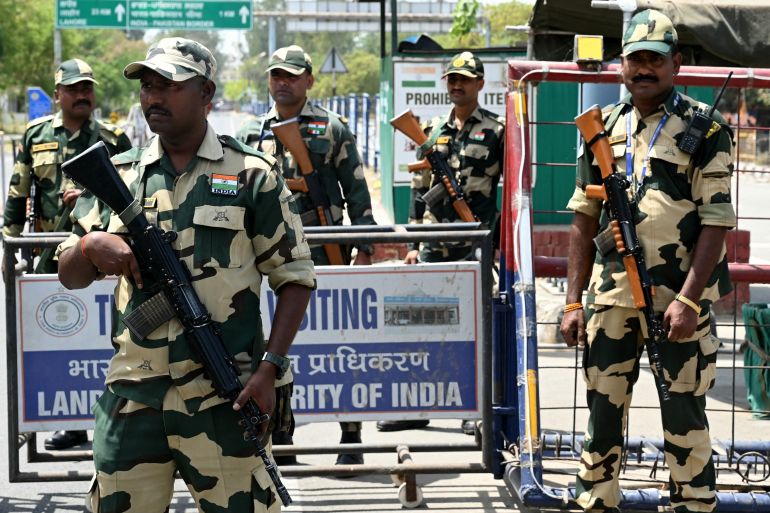
India labour code protests: Unions and farmers rally over new reforms, MSP demand


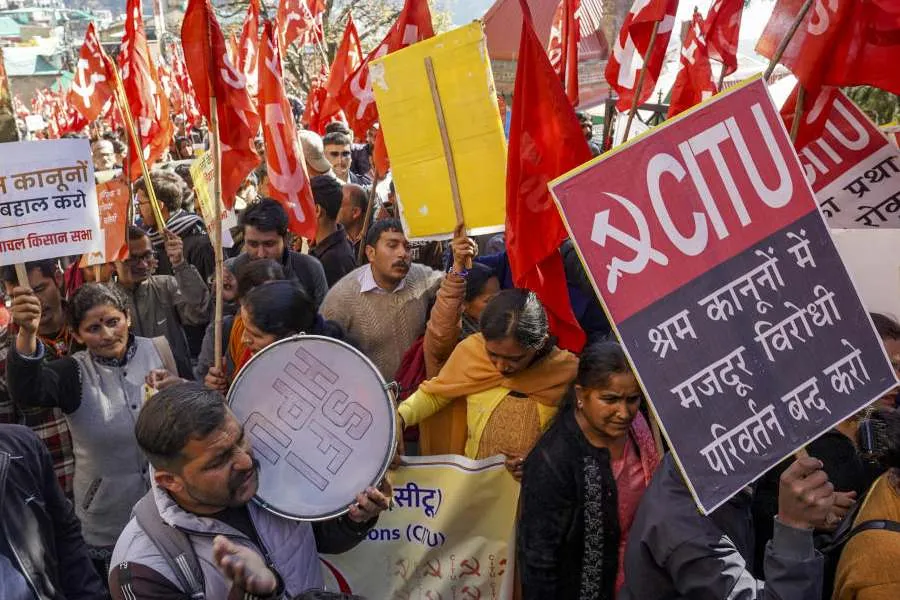
Protests took place across hundreds of districts after the Government of India began implementing four labour codes designed to consolidate and modernise the country’s regulatory framework for workers. Officials say the measures will introduce uniform wages, expand social security and streamline compliance, but labour organisations argue they remove key protections.
The mobilisation was coordinated by a coalition of 10 central trade unions, the farmers’ platform Sanyukt Kisan Morcha and the All India Power Engineers Federation. According to the All India Trade Union Congress general secretary Amarjeet Kaur, both formal and informal sector workers joined demonstrations in more than 500 districts.
The unions submitted a memorandum to President Droupadi Murmu outlining their opposition. The document stated that the new codes “negate our right to strike” and make it harder to register unions, while giving officials wider authority to revoke registration. The groups warned that replacing labour courts with tribunals would complicate dispute resolution and undermine long-standing rights.
Power sector workers also took part in the protests. The All India Power Engineers Federation chairman, Shailendra Dubey, said engineers objected to both the labour reforms and the proposed Electricity Amendment Bill. He argued that provisions allowing multiple private firms to use existing public distribution networks could accelerate privatisation. “The bill seems to support privatisation motives,” he said, adding that recent rules suggested a broader push towards opening the sector to corporate competition.
At Delhi’s Jantar Mantar, Hannan Mollah, a former Member of Parliament from the Communist Party of India (Marxist) and a leader of the farmers’ organisation All India Kisan Sabha, accused the government of failing to honour commitments. “The Modi government has betrayed the workers and farmers of this country. Farmers and workers are united in this fight against the government’s policies,” he said.
The Sanyukt Kisan Morcha renewed its long-standing demands, including a legally enforceable Minimum Support Price based on recommendations by the Swaminathan Commission, loan waivers for farmers, protection against electricity privatisation and an expansion of both employment days and wage rates under the national rural jobs scheme.
The protests came shortly after the central government formally notified the implementation of the four labour codes: the Code on Wages, the Code on Social Security, the Industrial Relations Code and the Occupational Safety, Health and Working Conditions Code. Together, these replace 29 earlier labour laws that have been in place, in some cases, for decades.
In an interview with the Indian Express, senior advocate Gayatri Singh said the reforms “totally” favour businesses. Singh, who specialises in labour and human rights law, argued that minimum wage protections had not been adequately extended to India’s vast unorganised workforce. She said several categories of workers, including agricultural labourers, health workers and gig economy workers, remained insufficiently protected due to what she described as vague definitions of “worker”, “employee” and “contractor”.
Singh noted that earlier judicial rulings had expanded the definition of an “industry” under the Industrial Disputes Act to cover a wide range of sectors, including charitable organisations and hospitals. She argued that these protections had been set aside because the new codes rely on narrower definitions. “All those judgments also go into the dustbin,” she said.
Concerns were also raised about wage calculations. Singh said the reforms replaced the earlier system of scheduled industries and introduced a central “floor wage” without clear criteria for determining it. She highlighted that an expert panel had once recommended a daily floor wage significantly higher than the figure later suggested by another committee, which she described as “starvation wages”.
She also expressed concern that women could be disproportionately affected by changes to the definition of wages. Singh said allowances such as housing and leave benefits, which often expose disparities between men and women performing similar work, were no longer included in the calculation of wages under the new framework. “Women are actually not being protected in terms of their wages and equal conditions of work,” she said.
On the question of whether earlier labour laws had been properly implemented, Singh acknowledged that compliance had been weak, but said that abandoning safeguards altogether left workers more vulnerable. Asked whether there were any positive aspects of the new codes, she responded that she saw “nothing” beneficial apart from a provision enabling gig and platform workers to register themselves, though she said the registration did not lead to meaningful security or benefits.
The government maintains that the new labour codes will enhance India’s economic competitiveness by simplifying regulations, encouraging investment and ensuring uniformity across states. However, trade unions, farmers’ groups and several legal experts argue that the reforms may increase job insecurity and weaken mechanisms that protect workers’ rights.
Context
Labour reforms have long been part of India’s efforts to modernise its regulatory environment and attract foreign investment. Supporters say the new codes could help create a more flexible labour market, reduce compliance burdens and encourage the growth of manufacturing and services. Critics, however, argue that these changes come at a time of rising informal work and limited social security coverage, and could deepen inequality if not accompanied by strong safeguards. Tensions over the Minimum Support Price have also persisted since the large-scale farmers’ protests of 2020 and 2021, reflecting broader concerns about rural incomes and market volatility.
Kerala Initiates Probe into 2006 Suicide Case Involving CEC

Extradition of Sheikh Hasina Feasible, Says Indian High Commissioner

Punjabi Makeup Artist Mad Sandhu Shot Dead in Amritsar
India Achieves Fourth Place at Asian Games 2026 Through Late Success