Adani Group Shifts Focus to Urban Development at Airports


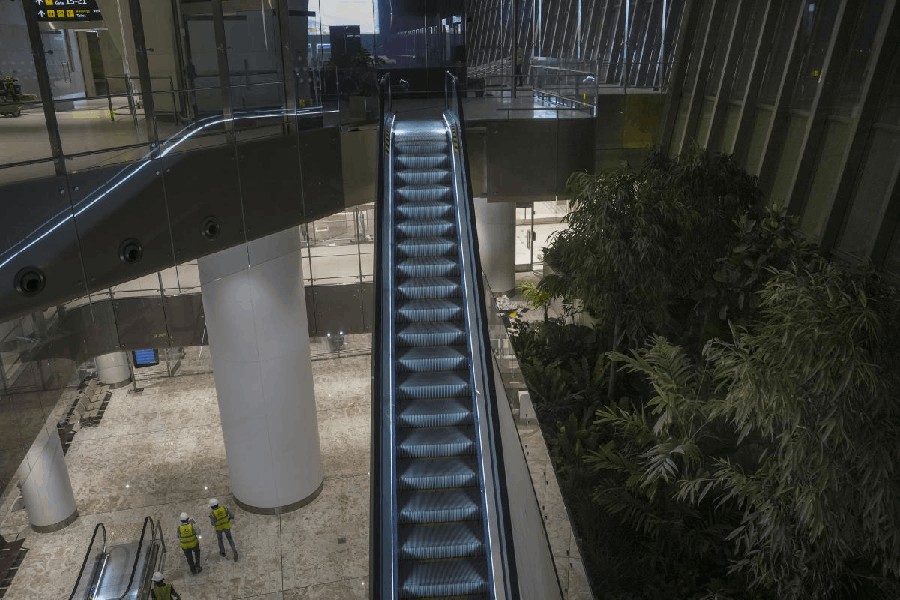
The Adani Group has announced a significant shift in its infrastructure strategy, opting to pause its international airport expansion efforts. Instead, the conglomerate is set to concentrate its capital and management resources on developing airport facilities within India. Jeet Adani, director of Adani Airport Holdings, stated that the group is redefining its approach, viewing airports not just as transport hubs but as multifaceted urban platforms. These platforms integrate aviation with real estate, retail, hospitality, and digital services, aiming for sustainable, high-margin growth.
As it stands, Adani Airports manages eight airports that collectively serve nearly 90 million passengers annually. Projections indicate that even without acquiring additional airports, passenger numbers across this network could rise to approximately 150 million over the next three to five years, driven by increased air travel demand and capacity enhancements. The group is also positioning itself to bid for several airports scheduled for privatisation, reinforcing its ambition to establish itself as a leading private airport operator in India.
Transitioning Revenue Models
A crucial driver behind Adani’s new focus on city-side development is the economic model of airport operations. Revenue generated from aeronautical sources, which includes landing fees and passenger service charges, is heavily regulated and typically yields returns of around 12%. In contrast, non-aeronautical revenue streams—such as retail, food and beverage, and premium services—can offer returns exceeding 20%. Currently, Adani’s revenue from these two sources is approximately evenly divided; however, Jeet Adani has indicated a strategic aim to reduce aeronautical revenue to about 10% of total income. In contrast, contributions from retail and other non-aeronautical ventures are expected to rise to between 40% and 50%, with city-side developments accounting for an additional 30% to 40%.
This transformation elucidates why, despite the airport business already being profitable before interest, taxes, depreciation, and amortisation (EBITDA), it has yet to achieve cash-positive status due to significant capital expenditures. Jeet Adani anticipates that the airports unit will generate positive cash flow within the next 18 to 24 months, thereby decreasing its reliance on Adani Enterprises for funding. The funding for its ambitious Rs 1 lakh crore expansion strategy will largely be sourced from internal accruals, complemented by project-specific debt and selective equity raises.
Maximising Passenger Engagement
Unlike traditional airport operators that focus primarily on passenger throughput, Adani’s strategy actively seeks to enhance the number of transactions per passenger. At present, approximately one in three passengers at its airports engage in a commercial transaction, with a goal to increase this ratio to one in two or more.
A key aspect of this initiative is Adani’s vertically integrated operational model. The group owns and manages most components of the airport ecosystem, including retail, dining, lounges, and ground handling services. This ownership structure allows for greater control over pricing, customer experience, and cross-selling opportunities. These operations are managed through two joint ventures, with Flamingo as the retail partner, and Travel Food and Services and AJ Kitchen of Abu Dhabi collaborating on food and hospitality services.
Urban Development as a New Frontier
One of the most significant aspects of Adani’s airport strategy is its aggressive foray into city-side development. Ongoing projects are underway in cities such as Ahmedabad, Mumbai, Navi Mumbai, and Lucknow, with plans for further expansion into Guwahati. These initiatives extend beyond mere terminal construction and parking facilities.
The Navi Mumbai International Airport exemplifies this vision, with the surrounding area being developed into a comprehensive urban destination featuring hospitality, retail, office space, entertainment venues, and a 25,000-seat arena, all integrated with aviation infrastructure. This approach aims to create a self-sustaining ecosystem where airports serve as economic anchors for their respective districts.
This strategy reflects global trends observed in cities like Amsterdam, Seoul, and Singapore, where airport-led urban clusters are generating significant value beyond aviation.
Expanding into Hospitality
According to The Times of India, the Adani Group is also gearing up for a substantial entrance into India’s hospitality sector, leveraging its airport and real estate operations. The group plans to develop over 60 hotels across the nation, primarily associated with its airport initiatives and major real estate projects. The majority of these hotels will be developed in-house, with the exception of the Sahara Star hotel located near Mumbai's Terminal 1.
Navi Mumbai is projected to host around 15 hotels, underscoring the group’s confidence in sustained demand across business travel, conventions, and leisure tourism. Rather than establishing its own hotel brand, Adani intends to collaborate with established global hospitality operators, capitalising on their expertise and networks.
Additionally, significant investments are planned in convention and events infrastructure, with a major convention centre and a large arena in Navi Mumbai aimed at attracting corporate events, exhibitions, and large gatherings. This clustering of aviation, hospitality, and commercial real estate is designed to stabilise income and mitigate reliance on airline traffic fluctuations.
Regulatory approvals are facilitating this expansion, with the Union Ministry of Environment, Forest and Climate Change recently sanctioning a Rs 136-crore luxury hotel project by Adani Airport Holdings at Thiruvananthapuram International Airport, indicating a growing acceptance of mixed-use developments associated with airports.
Digital Innovations and Strategic Shift
On the digital front, the group is refining its data management strategy. It has shifted away from a previous plan of creating a single super app for all Adani consumer businesses, instead focusing its digital efforts specifically on airports. This change has been influenced by concerns regarding data protection and compliance, with an aim to responsibly utilise passenger data to enhance monetisation and service quality across airport ecosystems.
A New Era of Airport Operations
The Adani Group’s pivot from airside operations to city-side development fundamentally alters the risk and return landscape of its airport business. By decreasing reliance on regulated aeronautical income while fostering diversified, high-margin revenue streams, the group is constructing a more resilient and scalable operation. This approach positions Adani not only as an infrastructure operator but also as a long-term urban developer, influencing the evolution of India’s next-generation cities and transport hubs. If successful, this model could revolutionise airport economics in India and serve as a blueprint for infrastructure-led urban development across the country.
Kerala Initiates Probe into 2006 Suicide Case Involving CEC

Extradition of Sheikh Hasina Feasible, Says Indian High Commissioner

Punjabi Makeup Artist Mad Sandhu Shot Dead in Amritsar

India Achieves Fourth Place at Asian Games 2026 Through Late Success