US Iran War: Hegseth Signals Escalation After Gulf Visit


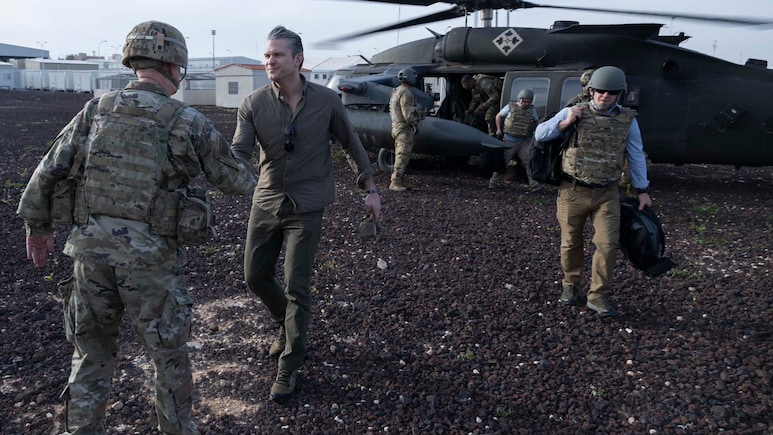
United States Defence Secretary Pete Hegseth has indicated that American troops may seek stronger military action in the ongoing conflict with Iran, following an undisclosed visit to forces stationed in the Gulf region.
Speaking after the visit, Hegseth said US personnel were prepared for a prolonged conflict and described growing calls within the ranks for more powerful weapons, as the war in West Asia entered its second month.
Troops signal readiness for prolonged conflict
Hegseth said he had spent time with US forces involved in what officials have termed “Operation Epic Fury”, a campaign launched jointly with Israel against Iranian targets.
“These troops want to finish this fight for their kids and their grandkids. This is about history, this is about legacy,” he said, emphasising the determination among personnel.
He added that some troops had expressed a desire for “larger bombs and weapons” to intensify operations against Iran, though he did not provide details of specific requests or planned deployments.
The defence secretary did not disclose the exact locations he visited, citing security concerns and the risk of potential targeting.
Uncertainty over ground operations
When asked whether US ground troops could be deployed, Hegseth avoided giving a direct answer, saying it would be unwise to reveal operational intentions.
“You can't fight and win a war if you tell your adversary what you are willing to do, or what you are not willing to do,” he said.
However, he indicated that a range of military options remained available if required, while also noting that diplomatic negotiations were ongoing.
“They are very real. They are ongoing, they are active, and I think, gaining strength,” he said of the talks aimed at ending the conflict.
Conflict timeline and regional impact
The conflict began on 28 February after the United States and Israel launched coordinated strikes following stalled negotiations over Iran’s nuclear programme.
Since then, hostilities have spread across multiple parts of the Gulf region, with reported attacks affecting cities including Dubai, Abu Dhabi, Doha and Manama.
Iran has responded with retaliatory strikes, raising concerns about broader regional instability and the safety of critical infrastructure.
US President Donald Trump has warned that Washington could expand its offensive if a ceasefire is not reached soon, particularly if key maritime routes remain disrupted.
Focus on strategic waterways
One of the central concerns in the conflict has been the disruption of shipping routes, particularly in the Strait of Hormuz, a vital corridor for global oil supplies.
US officials have warned that prolonged closure or instability in the strait could have significant consequences for global energy markets.
President Trump has suggested that further military action could target Iranian infrastructure if access is not restored.
Pentagon messaging and leadership role
Hegseth has emerged as a key public voice of the Pentagon during the conflict, frequently briefing the media and defending the administration’s strategy.
According to officials cited in US media reports, he has played a prominent role in communicating the progress of military operations, while maintaining a strong and combative tone in public appearances.
His approach has included emphasising battlefield successes and criticising coverage that questions the effectiveness or costs of the campaign.
At the same time, military planning and operational strategy are understood to be led by senior defence officials, including General Dan Caine, Chairman of the Joint Chiefs of Staff.
Balancing military pressure and diplomacy
Despite the escalation in rhetoric, US officials have continued to highlight diplomatic efforts aimed at resolving the conflict.
Hegseth suggested that negotiations could still provide a pathway to de-escalation, even as military preparations continue.
The dual-track approach reflects the broader US strategy of maintaining pressure on Iran while keeping channels open for dialogue.
Context: A widening and uncertain conflict
The war has now entered a critical phase, with both military and economic risks increasing as the conflict continues.
Analysts warn that any further escalation could draw in additional regional actors and disrupt global energy supplies, particularly if key shipping lanes remain affected.
The situation also underscores longstanding tensions over Iran’s nuclear ambitions and the limits of military solutions in addressing them.
As the conflict evolves, the United States faces a complex balancing act between sustaining military operations, managing domestic and international expectations, and pursuing a diplomatic resolution.
India's Jaishankar Criticises Pakistan at UN General Assembly
Iran Asserts Readiness for War Amid Rising Tensions in Hormuz
Israeli Prime Minister Netanyahu Makes Unannounced Visit to UAE

World Leaders Gather for Climate Summit, Pledges Made