Trump and Xi Discuss Trade, AI, and Taiwan Amid Diplomatic Tensions


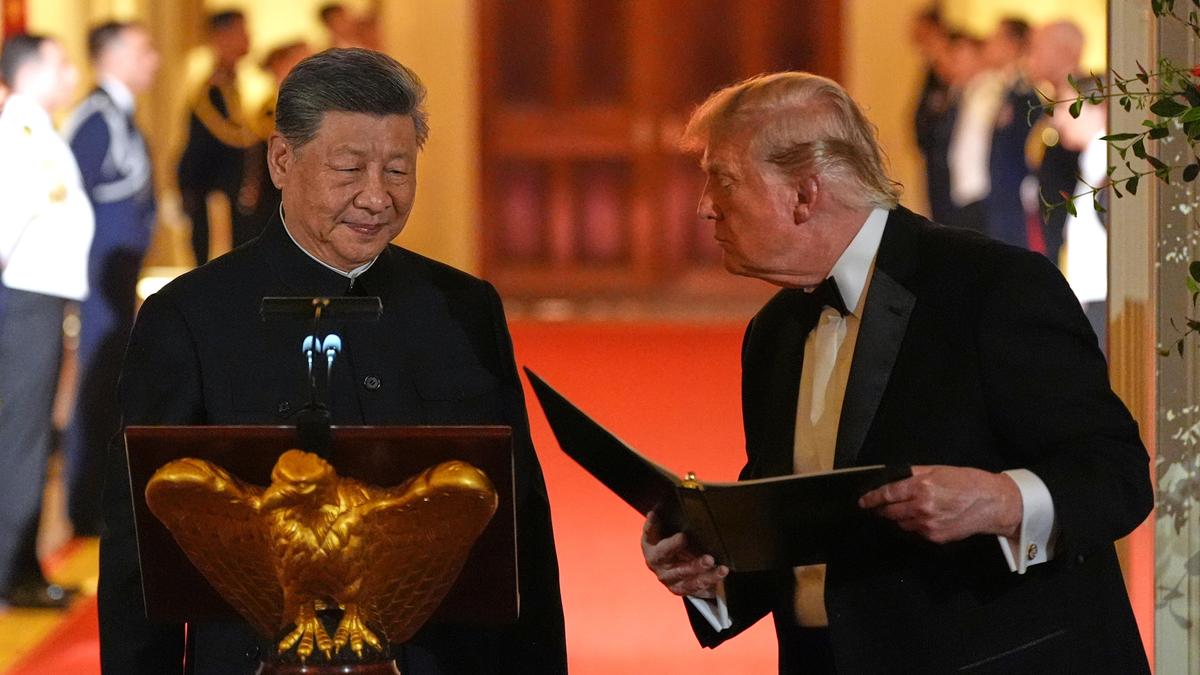
United States President Donald Trump and Chinese President Xi Jinping have engaged in dialogues centred on trade relations, the development of artificial intelligence, and Taiwan during recent meetings. These discussions take place against a backdrop of escalating tension between the two global superpowers.
At a state dinner held in Washington, Trump presented Xi with a sculpture of a bald eagle, an emblematic symbol of the United States. Trump stated that the statue represents 'the free and soaring spirit of America'. This gesture was aimed at strengthening the personal relationship between the two leaders, a vital aspect of their ongoing diplomatic efforts.
Daniel Kritenbrink, a partner at The Asia Group and a former U.S. diplomat, noted the importance of personal connections in high-stakes diplomacy. 'They're going to discuss all of these complicated issues,' Kritenbrink said, highlighting that personal rapport is crucial in such interactions.
This meeting marked the third face-to-face encounter between Trump and Xi since the beginning of Trump’s second term. The talks were particularly significant as both leaders navigated pressing issues, including the competitive race for dominance in the field of artificial intelligence.
During these discussions, it was made clear that economic challenges remain at the forefront of their agenda. The two nations are seeking to manage the implications of a trade war that has persisted for years, although a temporary truce has been established. The shifting dynamics in global trade have raised alarms about potential economic repercussions should tensions intensify further.
In a parallel diplomatic gesture, Xi announced the gifting of two giant pandas to a zoo in Atlanta, as well as a new educational exchange programme to welcome 100,000 American students to study in China over a five-year period. This measure aims to enhance people-to-people ties and promote understanding between the two nations.
Highlighting the complexities involved in international gift-giving, Ole Jacob Sending from the Norwegian Institute of International Affairs remarked that gifts function as tokens of diplomacy within a broader context. In democracies like the United States, there are strict regulations governing the value of gifts that officials can accept from foreign leaders. The emoluments clause of the U.S. Constitution limits such gifts to a maximum worth of $525 (£397).
The significance of gift exchanges takes on a deeper layer when one considers their potential effect on diplomatic relations. Criticism has previously arisen regarding less thoughtful gift exchanges that have occurred in international politics. Past exchanges have included a bench gifted by former President Barack Obama to Xi during a 2013 visit, which contrasted unfavourably with other, more awkward exchanges in history.
The current discussions arrive amidst rising concerns around artificial intelligence and its implications for global stability. Both nations are competing vigorously to lead in this critical area, drawing attention to the need for collaborative approaches towards emerging technologies that could shape the future.
In conclusion, as the spectre of an AI-led future looms, the need for stable U.S.-China relations becomes ever more pronounced. Critically, both leaderships seem committed to engaging in dialogues that may avert escalatory paths in trade and technology. Observers are left analysing the outcomes of their recent meetings, as the world looks on in anticipation of constructive developments from these two influential states.
United States Invites Vladimir Putin to Miami G20 Summit

Prime Minister Modi Engages Youth in Seva Sankalp Yatra Initiative
Indian CDS Subramani Advocates Stronger Military Networks
Congress Criticises BJP Over Goa CEO's Communication with ECI