Spain's Northern African Enclaves: A Historical Overview


Spain's two small territories on the northern coast of Africa, Ceuta and Melilla, have been a longstanding point of contention in its relationship with Morocco. These enclaves, which are the only European territories located on African land, also include several rocky islands known as Plazas de Soberanía, such as the Chafarinas Islands and the Alhucemas Islands. While Spain asserts its ownership of these locations, Morocco disputes this claim, demanding their return since gaining independence from France in 1956. This territorial dispute contributes to ongoing political tensions between the two nations.
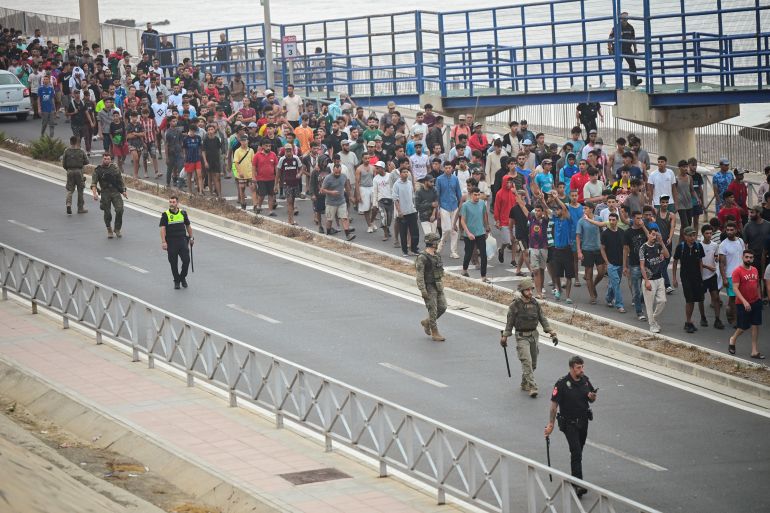
Recently, the situation escalated when over 50,000 migrants crossed into Ceuta, heightening the already strained relations between Madrid and Rabat. Although many migrants returned to Morocco, thousands remained in Ceuta, complicating local dynamics and increasing pressures on both governments.
The historical backdrop of Spain’s control over these enclaves is rooted in the colonial era. Ceuta was first seized by the Portuguese in 1415 before becoming part of Spanish territory in 1580. Melilla was taken by a Spanish nobleman in 1497. After the Portuguese regained independence in 1640, Spain maintained control over Ceuta. As noted by Yolanda Aixelà Cabré, an anthropologist at the Institute of Mediterranean and Middle Eastern Studies in Barcelona, Spain expanded its influence to Africa following the loss of its colonial holdings in Latin America in 1898.
Today, Ceuta and Melilla are seen as the last remnants of Spain’s colonial empire on the African mainland. Despite their geographic location in Africa, they are considered Spanish territory and form part of the European Union's external border. This makes retaining these enclaves symbolically significant for Spain, reinforcing a sense of national identity rooted in its imperial past.
Historians suggest the survival of Ceuta and Melilla as separate entities stems from their historical origins, which precede the concept of modern Morocco. Selim Balouati Lakhloufi, a historian focused on North African history, points out that these enclaves have been occupied by Spain for centuries. Following Morocco's independence, the territorial claims over Ceuta and Melilla, referred to as Sebtah and Melilah by Morocco, have been a significant issue in the bilateral relations between the two countries. Moroccan political leaders frequently utilise this issue as a form of criticism against Spain.
Samir Bennis, a senior political adviser based in Washington, indicated that Morocco has made territorial claims on Ceuta and Melilla central to its assertive stance towards Spain since independence. Interesting factors contribute to Morocco’s approach concerning these enclaves. One factor is the scale of pending territorial disputes with Spain, which led the Moroccan government to adopt a gradual strategy for recovery. The second factor was the Spanish government’s willingness to engage in dialogues to resolve these disputes, ultimately benefiting Spain’s interests.
Bennis suggested that while Morocco's claims are contextually weak, they are bolstered by historical and geographical arguments that challenge Spain’s position. Jamie Trinidad, a law fellow at Wolfson College, Cambridge, echoed this sentiment, commenting that Morocco's stance lacks a firm basis under international law and resembles Spain's historical claims to Gibraltar, a British Overseas Territory located nearby.
Morocco sought to have Ceuta and Melilla included on the United Nations’ list of Non-Self-Governing Territories in the 1970s. However, its request was not acted upon by the UN. Currently, Ceuta has a population of approximately 84,000 residents, while Melilla is home to around 86,000 people. Both enclaves have diverse populations, including Christian and Muslim residents of Spanish and Moroccan backgrounds.
Tensions in Ceuta intensified after the recent influx of migrants. Local residents protested against an anticipated far-right anti-migrant rally, highlighting the complex and often fraught social dynamics within the enclave. One Ceuta resident remarked on the fragile coexistence between different communities, expressing fears brought about by the recent changes in their local environment. Such events underscore the delicate balance and challenges faced in these enclaves, further complicating Spain’s already intricate relationship with Morocco.

ABVP Wins Majority in Delhi University Students' Union Elections

Rahul Gandhi Criticises Modi Government's Attitude Towards Students

Delhi Chief Minister Faces Scrutiny Over Ongoing Notices

Former Union Minister Detained in Punjab Protest Against CM