South Korea Hits Record Temperature Amid Ongoing Heatwave


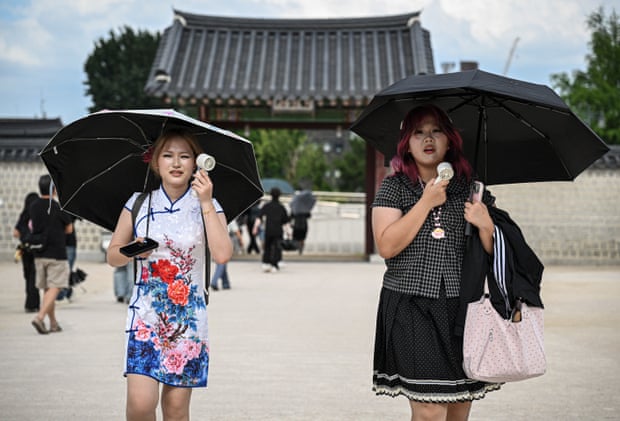
South Korea has registered its highest recorded temperature since modern weather observation began over a century ago. The Korea Meteorological Administration (KMA) reported that the south-eastern city of Yangsan recorded a temperature of 42.5 degrees Celsius on Sunday afternoon. This extreme reading marks the fifth consecutive day temperatures have exceeded 40 degrees Celsius in the region, intensifying a heatwave that has prompted heightened alerts throughout the country.
In addition to Yangsan, other cities including Daegu and Busan have also experienced high temperatures, with many areas climbing into the upper 30s. Authorities are urging residents to stop all outdoor activities immediately in these regions. Indoor spaces lacking air conditioning have been classified as 'dangerous,' further compelling individuals to seek shelter in air-conditioned venues such as shopping malls and cafés.
Ju Dong-yeol, a 27-year-old office worker, described his experience in a Starbucks in South Korea’s capital, saying, "it is too hot to be outside doing anything." He added, "I can’t think of anything else to do other than stay in air-conditioned places like home, shopping malls and cafés."
The city of Gyeongju, located approximately 240 kilometres south-east of Seoul, recorded a high of 40.3 degrees Celsius on Sunday, its highest in eight years. The oppressive heat is also being felt across the border in North Korea, where state media reported temperatures reaching 40 degrees Celsius in certain regions. Residents in Pyongyang have endured nights with temperatures not dropping below 25 degrees Celsius over the past week.
On Sunday, more than 20 areas across South Korea were placed under emergency heatwave alerts, a new warning system implemented this year to address rising temperatures. An emergency alert is triggered when forecasts predict perceived temperatures of 38 degrees Celsius or actual temperatures of 39 degrees Celsius. In issuing warnings, the KMA advised people to “immediately stop all outdoor activities” and to find refuge in designated cooling areas or shaded spaces while maintaining hydration.
In light of the heatwave, South Korean Prime Minister Han Seong-sook has directed local officials to enhance safety checks on vulnerable populations and ensure reliable power and water supplies. Forecasts indicate that easterly winds may drive the extreme heat further inland on Monday, with Seoul expected to reach a temperature of 37 degrees Celsius. The KMA anticipates temperatures in South Jeolla and South Gyeongsang to exceed 39 degrees Celsius, creating conditions that may pose life-threatening risks.
Officials are also monitoring Typhoon Dolphin, which is presently moving towards the southeast coast of China, south of the Korean peninsula. The storm's trajectory could influence the duration of the unbearable heat. Should the typhoon steer towards eastern China, it may exacerbate humidity levels, thus intensifying the existing heatwave. Conversely, if it approaches the southern areas of the peninsula, the storm could bring stronger winds and cloud cover, providing some respite from the heat.
Data from the KMA reveals that the average annual incidence of heatwave days has more than doubled to 19 in the past five years, with a heatwave day defined as one where the maximum temperature reaches at least 33 degrees Celsius.
In response to the soaring temperatures, South Korea's professional baseball league cancelled a game in Changwon after the city’s temperature hit 39.5 degrees Celsius, marking the second consecutive cancellation of games in the area. The Korea Baseball Organization released a statement that prioritised the safety and health of spectators and players amid the ongoing severe heatwave warnings.
Scientists have highlighted that extreme weather events such as heatwaves are becoming increasingly frequent and severe as a consequence of anthropogenic climate change. This year's return of El Niño, a natural climatic occurrence that raises Pacific Ocean surface temperatures, is also contributing to the extreme weather conditions, typically occurring every two to seven years.

Indian Government Declares Shahzad Bhatti Network a Terrorist Outfit

PM Modi Helps Former Schoolmate Recover Land After Long Dispute

Naval Collision in Arabian Sea Heightens India-Pakistan Tensions

Telangana CM Launches Inquiry Into Alleged Land Irregularities