India–GCC Free Trade Talks Launched With Signing of Framework


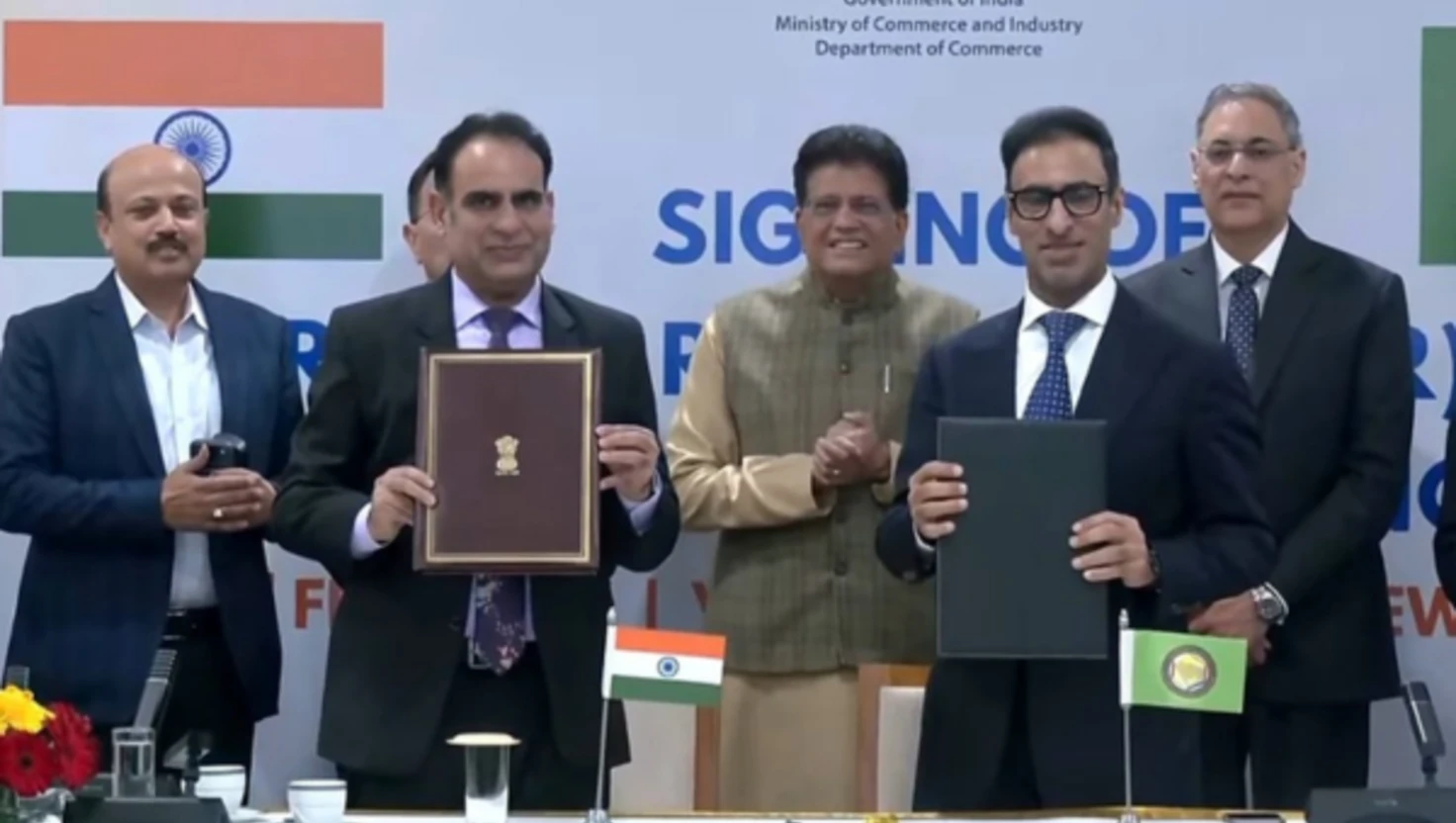
India and the Gulf Cooperation Council have formally agreed to begin negotiations for a free trade agreement after signing a framework document in New Delhi, a move both sides say could significantly expand trade and strengthen long-term economic cooperation.
The Terms of Reference, which set out the scope and structure of the negotiations, were signed in the presence of Indian Commerce and Industry Minister Piyush Goyal. The agreement brings together India and the six-member Gulf Cooperation Council, which includes the United Arab Emirates, Saudi Arabia, Qatar, Kuwait, Bahrain and Oman.
Speaking at the signing ceremony, Mr Goyal said the decision marked the opening of a new and strategically important trade corridor for India. He described the agreement as a step towards a formal free trade pact that would support growth, investment and supply chain resilience on both sides.
“This is the right time for India and the GCC to enter into a comprehensive trade agreement,” Mr Goyal said, adding that the proposed pact would help diversify India’s energy sources and strengthen long-term supply security.
Trade scale and economic ties
According to India’s Commerce Ministry, trade between India and the GCC countries currently stands at around 170 billion US dollars a year. The Gulf region is one of India’s largest trading partners, particularly for crude oil, natural gas and petrochemical products.
Mr Goyal said around 10 million Indian citizens live and work in GCC countries, underlining the depth of people-to-people links alongside commercial ties. He added that a free trade agreement could deliver benefits across a range of Indian industries, including food processing, infrastructure development, petrochemicals and information and communications technology.
The minister said the agreement would allow for a smoother flow of goods and services and was expected to encourage greater two-way investment. He also noted that India had been steadily expanding its network of trade agreements as part of a broader strategy to integrate more deeply with global markets.
Resumption of stalled negotiations
The signing of the Terms of Reference marks a revival of trade discussions that were first explored between India and the GCC in the mid-2000s but did not progress to a formal agreement at the time. Officials say the renewed talks reflect changing economic priorities and a shared interest in reducing trade barriers.
India already has bilateral trade arrangements with several Gulf states. A comprehensive economic partnership agreement with the United Arab Emirates came into force in May 2022, and a similar pact with Oman was signed in December 2025. These agreements are seen by policymakers as building blocks for a wider regional framework.
Indian exports to Gulf countries include precious and semi-precious stones, metals, jewellery, machinery, iron and steel products and chemicals. In return, India imports large volumes of energy products, making the region critical to its energy security.
Energy diversification and global context
Mr Goyal said the proposed agreement with the GCC could play a role in diversifying India’s energy supplies, a comment that has drawn attention in light of recent global developments. India has been seeking to balance its energy imports amid shifting geopolitical conditions and volatile global markets.
Reuters reported that the minister’s remarks came shortly after the announcement of a separate trade deal framework between India and the United States. Following that announcement, United States President Donald Trump claimed India would reduce its energy ties with Russia, though Indian officials have not formally confirmed any such commitment.
Addressing reporters, Mr Goyal said India’s trade policy decisions were guided by long-term national interests, including growth, stability and energy security, rather than short-term political considerations.
Political and diplomatic backdrop
The agreement with the GCC follows a period of active diplomatic engagement between India and Gulf nations. It comes weeks after United Arab Emirates President Sheikh Mohamed bin Zayed Al Nahyan made a brief visit to India, during which he met Indian Prime Minister Narendra Modi and reviewed the full scope of bilateral relations.
The move has also been viewed against the backdrop of shifting regional dynamics in West Asia. Saudi Arabia, a key GCC member, maintains close ties with Pakistan, and in September 2025 Riyadh and Islamabad signed a strategic defence agreement that drew attention across the region.
Indian officials have not publicly linked the trade talks to regional security issues, but analysts say deeper economic engagement with the Gulf could help New Delhi strengthen its strategic presence and partnerships in the region.
Next steps
With the Terms of Reference now signed, negotiators from India and the GCC are expected to begin detailed discussions on tariff reductions, market access and regulatory cooperation. Officials have not set a public timeline for the conclusion of talks, but both sides have indicated an interest in moving quickly.
Mr Goyal said the agreement with the GCC would complement India’s other trade initiatives and help position the country as a reliable economic partner. He added that India was also preparing to announce the first tranche of a trade deal agreed with the United States, which he said would become India’s ninth free trade agreement.
If concluded, the India–GCC free trade agreement would rank among the most significant economic partnerships for both sides, linking one of the world’s fastest-growing major economies with a region that plays a central role in global energy and trade flows.
ABVP Wins Majority in Delhi University Students' Union Elections
Rahul Gandhi Criticises Modi Government's Attitude Towards Students
Delhi Chief Minister Faces Scrutiny Over Ongoing Notices

Former Union Minister Detained in Punjab Protest Against CM