India Denies New $2 Billion Submarine Deal with Russia


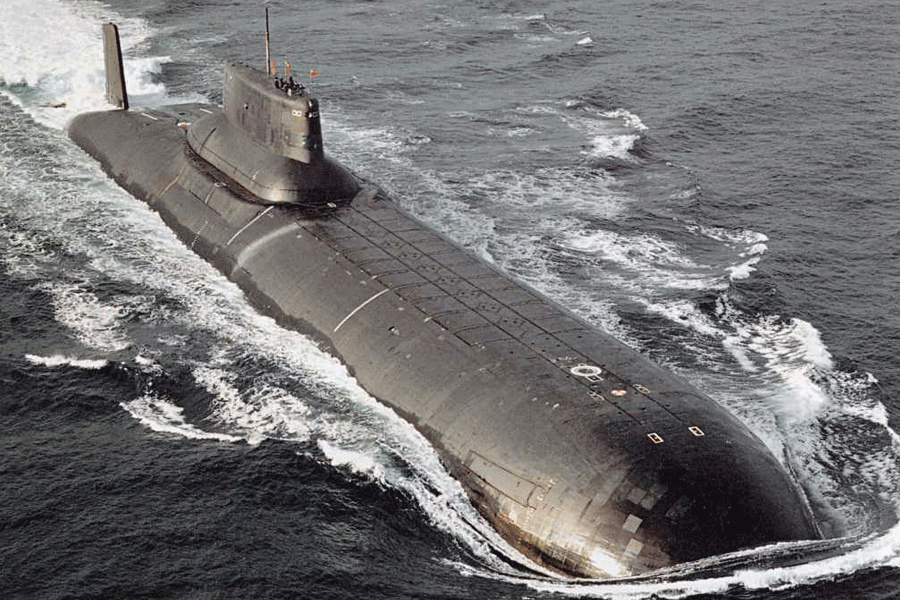
India's government has issued a statement denying the existence of a new submarine deal worth $2 billion with Russia, refuting a report published by Bloomberg. The government clarified that the claim, which emerged ahead of Russian President Vladimir Putin's visit to New Delhi, is misleading. According to a post by the Press Information Bureau, the arrangement mentioned in the Bloomberg article relates to a lease agreement signed in March 2019, which is still pending delivery, now expected in 2028.
The existing contract involves leasing a nuclear-powered attack submarine from Russia, following extensive negotiations. While the Bloomberg report indicated a finalisation of terms, the government emphasised that there is no new agreement in place. It stated that the submarine project is linked to prior commitments rather than a fresh deal.
Sources cited by Bloomberg revealed that discussions over the price of the submarine had faced multiple delays before an agreement was reached. Indian officials visited a Russian shipyard in November to assess the production progress of the vessel, which is intended for a 10-year lease, primarily for training purposes, and is not permitted for active combat.
The introduction of a nuclear-powered submarine is significant as it represents a step forward in India's naval capabilities. Nuclear-powered submarines are known for their ability to remain submerged for extended periods, operate more silently, and cover larger distances compared to traditional diesel-electric submarines. Currently, India operates 17 diesel-electric submarines and has developed its own ballistic missile submarines for nuclear deterrence.
India had previously returned a leased Russian nuclear submarine in 2021 after the conclusion of a 10-year contract. The new lease agreement also includes provisions for maintenance and logistical support throughout its duration.
Vladimir Putin's visit to India marks his first trip since Russia's full-scale invasion of Ukraine. His agenda includes discussions with Indian Prime Minister Narendra Modi on various topics, such as trade expansion and the potential establishment of RT's presence in India. This visit occurs against a backdrop of increasing strategic competition in the Indo-Pacific, where nations like Australia and South Korea are also pursuing advancements in nuclear submarine programmes.
Only a limited number of countries, including the United States, the United Kingdom, France, China, and Russia, currently operate nuclear-powered submarines. Meanwhile, India is actively working on its own nuclear-powered attack submarines to bolster its naval capabilities and is preparing to induct its third ballistic missile submarine next year.
Prime Minister Modi has maintained diplomatic relations with both Russia and China, navigating complex global dynamics while simultaneously discussing trade matters with the United States. The Ministry of External Affairs and the Defence Ministry have yet to comment on the revised delivery schedule for the submarine project.
Kerala Initiates Probe into 2006 Suicide Case Involving CEC
Extradition of Sheikh Hasina Feasible, Says Indian High Commissioner

Punjabi Makeup Artist Mad Sandhu Shot Dead in Amritsar

India Achieves Fourth Place at Asian Games 2026 Through Late Success