Europe Faces Multiple Bomb Threats Targeting Airlines and Airports


In a series of alarming incidents, at least 21 aircraft and multiple airports across Europe have been subjected to bomb threats, marking the second such occurrence within a week. The United Kingdom has labelled the threats as 'malicious hoaxes.' Flights heading to Austria, Belgium, Bulgaria, the Czech Republic, France, Italy, Poland, and Romania were notably affected by these threats.
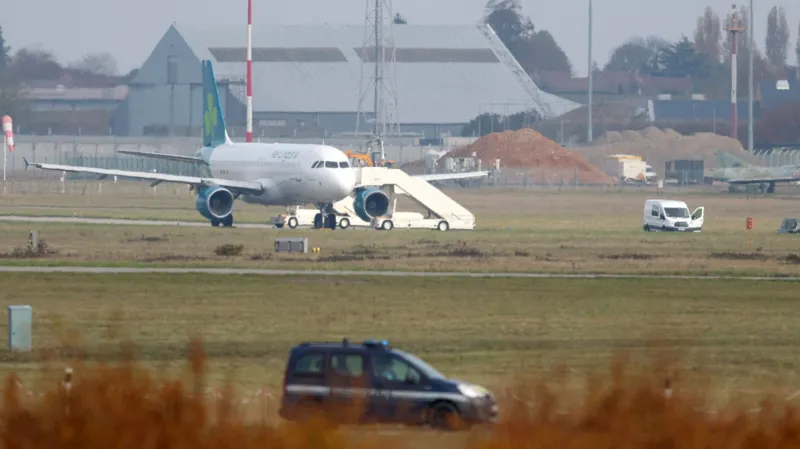
An Aer Lingus flight from Dublin to Rome was redirected to a military air base in France due to a bomb scare, while Italian fighter jets escorted a Finnair flight from Helsinki to Rome for safety concerns. EasyJet confirmed that its flights departing from Newcastle and Glasgow were met by police upon arrival in Prague.
Authorities at London Heathrow and Birmingham airports also received threats that were subsequently assessed as not credible. Extensive searches revealed no explosives on any of the affected flights.
The incident on Thursday was particularly concerning given that the threats had been communicated via email to airports in Rome. According to Aeroporti di Roma, which manages the city’s airports, the email was sent by a group or individual referring to themselves as 'Fighters of the Male State.' This entity claimed to be targeting a 'feminist regime' and threatened to 'turn the skies red' with explosions.
Italian media first reported on this development, which was later confirmed by Aeroporti di Roma. Experts noted that the name 'Fighters of the Male State' likely corresponds to the Russian group known as 'Muzhskoi Legion,' an ultra-nationalist group banned in Moscow in 2021 for its extremist views yet still boasting a significant online following.
UK Transport Secretary Heidi Alexander condemned the incidents, labelling them as 'malicious hoax threats.' She emphasised the seriousness of such threats and affirmed that established procedures for addressing similar situations are in place. A spokesperson for the UK government indicated that the threats reported earlier on Thursday had been 'resolved,' though no further details were provided.
Heathrow Airport clarified that it had received a threat earlier in the day, which was assessed as 'non-credible.' The airport added that there was no risk posed to passengers or staff. Meanwhile, a representative from Birmingham Airport noted that following the threat, emergency protocols were activated in collaboration with local law enforcement.
Emily Noble, a passenger on the diverted Aer Lingus flight, recounted the experience after the plane had been airborne for roughly an hour when passengers were informed of a 'technical' issue. She later learned that it was, in fact, a security concern. 'It was worrying because we didn't know what was going on,' she stated. As the flight circled for an unplanned landing, she witnessed fighter jets accompanying the aircraft.
Once at the Évreux-Fauville air base in Normandy, passengers were held on the plane for an extended period while thorough checks were conducted by police and military officials. After two-and-a-half hours, they were informed they would be transported to a Paris airport, where a separate flight would take them to Rome.
Philip Baum, a professor of aviation security at Coventry University, mentioned that such bomb threats are a regular occurrence in the aviation industry. However, he expressed surprise at the frequency of recent incidents. Baum pointed out that flights are only diverted when a threat seems credible and when there is a belief that an explosive device might be on board.
Marco Chan, an aviation expert at Kingston University, suggested that while the threats appear to be hoaxes, it remains prudent for authorities to treat them as credible until proven otherwise. He indicated that some experts view these threats as 'part of a pattern of cheap, deniable disruption' aimed at air travel.
This series of events follows another wave of bomb threats just days prior, where seven flights across Europe were subjected to similar scrutiny but similarly found no explosives. On Monday, a Wizz Air flight from London Luton Airport to Sofia was redirected to Budapest, escorted by a Hungarian fighter jet due to a mid-air bomb threat.
The investigation into these threats continues, as authorities strive to ascertain whether they are solely hoaxes or if a more coordinated effort is at play. The spontaneous nature of such threats raises concerns surrounding public safety and the implications of potential complacency in the aviation sector.

Supreme Court Clarifies Detention and Arrest Procedures in India
Indian Government Delays Decision on UGC Rules Amid Criticism

Modi Government Extends Agnipath Scheme Amid Youth Discontent

Hyderabad Startup Launches India's First Private Space Debris Facility