China's Zhuque-3 Rocket Launch: Recovery Attempt Fails


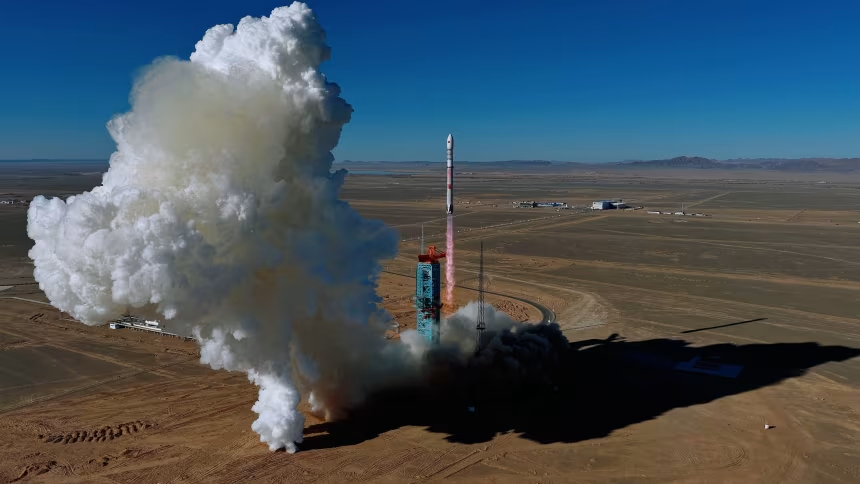
China's ambition in reusable rocket technology faced a setback with the recent launch of the Zhuque-3 rocket by the Beijing-based company LandSpace. The rocket lifted off from the Jiuquan Satellite Launch Centre in the northwest of China at midday on Wednesday. After successfully reaching low-Earth orbit, the lower stage of the rocket, responsible for the initial lift-off, reportedly caught fire during the descent phase.
LandSpace confirmed that the first stage encountered an anomaly while attempting to land, which ultimately resulted in a crash near the designated recovery site. The company stated on social media, "The debris landed on the edge of the recovery pad, resulting in a failed recovery test. The specific cause is under further investigation."
This incident marks a significant moment in the ongoing competition in the space industry, particularly as the United States remains the only nation to have successfully recovered an orbital-class booster. While other nations, including China, are making strides in this field, they are still working towards achieving similar milestones.
Founded in 2015, LandSpace has positioned itself as China's primary private rocket manufacturer, drawing parallels with SpaceX, the American aerospace company founded by Elon Musk. The company has focused heavily on developing reusable rockets, which are intended to reduce the costs associated with launching satellites into space.
LandSpace's previous achievement in 2023 was the launch of Zhuque-2, notable for being the first rocket powered by methane and liquid oxygen to reach orbit. The Zhuque-3 is a larger model, constructed from stainless steel, with the capability to carry between 20 to 25 tonnes to low-Earth orbit.
If successful, the Zhuque-3 would place LandSpace among a select group of companies, becoming the first private Chinese entity and only the third globally, after SpaceX and Blue Origin, to effectively land a large booster intended for reuse. This goal aligns with China's broader strategy to enhance its private sector's role in the space industry, as the country seeks to secure a greater share of global launch contracts.
The engineering challenges associated with building reusable rockets are significant, and while SpaceX has established itself as a leader in this area, LandSpace's efforts indicate a growing capability within China's private space sector. As noted by the company, "As low-orbit constellation deployment accelerates, Zhuque-3 will progress from recovery demonstrations to routine reuse and toward airline-style operational cadence."
The implications of successful reusable rocket technology extend beyond cost savings; they also play a crucial role in supporting China’s ambitions in satellite deployment and space exploration. Beijing is keen to establish a competitive presence in the commercial space sector, leveraging the innovation and agility of private firms like LandSpace.
Despite this setback with the Zhuque-3, LandSpace's ongoing developments reflect a commitment to achieving breakthroughs in space technology, and the company is expected to continue pursuing its goals of enhancing China's capabilities in the realm of reusable rockets. With future launches anticipated, the coming months may prove critical for both LandSpace and China's aspirations in the global space race.

Kerala Initiates Probe into 2006 Suicide Case Involving CEC

Extradition of Sheikh Hasina Feasible, Says Indian High Commissioner

Punjabi Makeup Artist Mad Sandhu Shot Dead in Amritsar

India Achieves Fourth Place at Asian Games 2026 Through Late Success