Challenges Plague India's Electric Vehicle Market Amid Oil Crisis


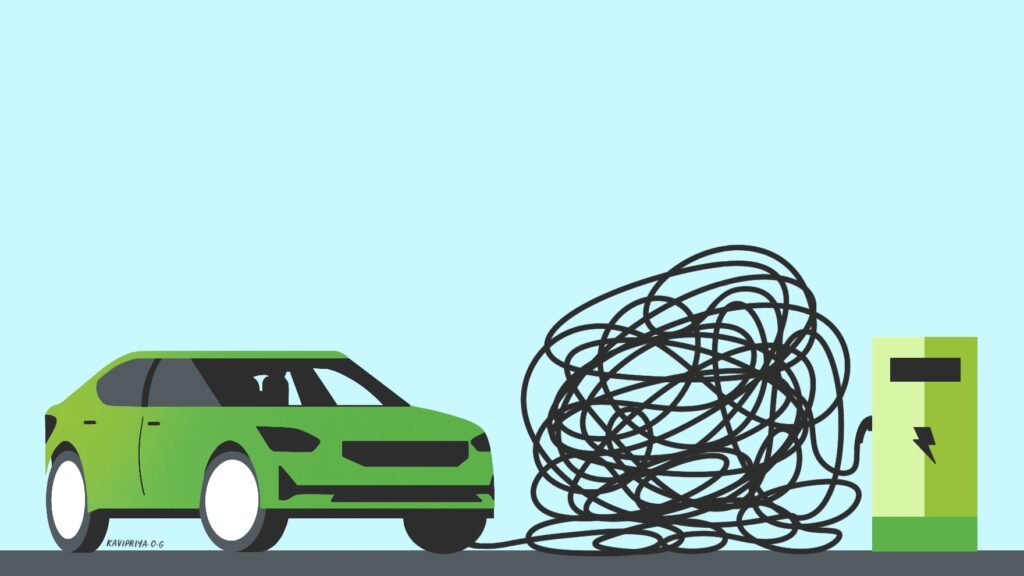
India's electric vehicle (EV) ambitions face significant hurdles amidst rising oil prices caused by geopolitical tensions in the Middle East. Prime Minister Narendra Modi's recent call for citizens to adopt EVs comes at a critical time when the nation is grappling with an oil import bill exceeding $10 billion per month. The shift from fossil fuels to electric vehicles is viewed as a potential economic relief. However, consumer enthusiasm appears to be waning due to a fragile supporting ecosystem.
The government and industry stakeholders are keenly aware of the financial disparity: while the monthly bill for oil imports is astronomical, the expenditure on lithium-ion batteries—a key component for EVs—stays at approximately $500 million. This alarming contrast underscores the imperative of transitioning towards electric options.
Despite initial optimism, major companies are revising their projections. Tata Motors, once aiming for 50% of its sales to stem from EVs by 2030, has recently lowered that expectation to 30%. Mahindra is contemplating a hybrid approach, retrofitting traditional vehicles with combustion engines, while Honda is scaling back its EV strategy within India.
These shifts in strategy are driven largely by the nation's inadequate charging infrastructure and after-sales service. Industry experts have drawn comparisons with China, where EVs dominate over 50% of the auto market, attributing this success to robust infrastructural investments made prior to the increased push for EV adoption. A former executive from Mercedes-Benz emphasizes this point, stating, "China built the infrastructure first, pushed for the EV later." Interestingly, companies like BYD started with battery production before venturing into manufacturing electric vehicles.
India's scenario starkly contrasts this model; the country is currently experiencing significant after-sales service challenges and a virtually non-existent used EV market. Many charging stations are non-functional due to maintenance issues and inconsistent electricity supply. The low investment return from a significant budget allocation of Rs 1 lakh crore (approximately £10 billion) aimed at bolstering EV initiatives raises concerns amongst stakeholders.
Industry insiders stress that without addressing these critical infrastructure deficiencies, India's path to an electric vehicle future is likely to remain hindered. The current situation highlights the need for a coordinated approach to build a sustainable EV framework that can adequately support both consumer adoption and the overall goal of reducing oil dependency.
Kerala Initiates Probe into 2006 Suicide Case Involving CEC

Extradition of Sheikh Hasina Feasible, Says Indian High Commissioner

Punjabi Makeup Artist Mad Sandhu Shot Dead in Amritsar

India Achieves Fourth Place at Asian Games 2026 Through Late Success