Bihar Chief Minister's Controversial Act Sparks Public Outcry


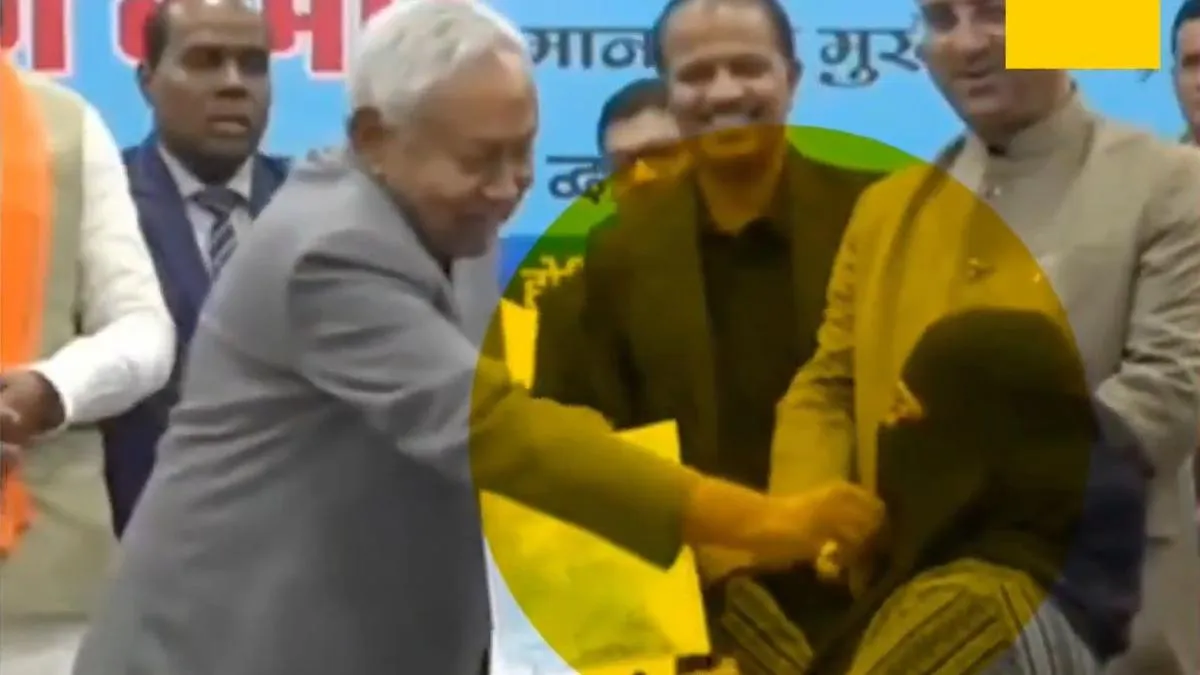
Last week, a video of Bihar Chief Minister Nitish Kumar went viral, showing him forcibly removing the hijab of a woman during an official function. This event was part of a government initiative under the AYUSH scheme, aimed at distributing appointment letters to newly hired doctors. The incident has drawn widespread criticism and raised questions about the treatment of women in public spaces in India.
In contemporary India, securing a government job has become a significant milestone, often celebrated through formal ceremonies where newly appointed individuals line up to receive their appointment letters from high-ranking officials, including chief ministers and prime ministers. Such events have transformed into performative acts, with the leaders being perceived as bestowing blessings upon the recipients, akin to religious offerings. This practice, however, has sparked discussions about the erosion of individual dignity in the country.
The recent encounter has highlighted a troubling trend where the rulers are increasingly viewed as parental figures, with citizens being treated as their children. This dynamic raises concerns over personal autonomy and respect, as well as the implications of such treatment on societal norms. The incident where Nitish Kumar pulled off the woman's hijab has been described by observers as not only humiliating but also indicative of a broader issue regarding the respect for personal boundaries.
Witnesses noted that Kumar appeared to be smiling during the act, while officials near him shared in the laughter. The woman, on the other hand, was visibly taken aback and shaken by the encounter. Reports suggest that she is now reconsidering her decision to accept employment in the state, reflecting the deep-seated confusion and discomfort stemming from the incident.
Despite the backlash, Nitish Kumar has yet to express any remorse for his actions. Government representatives have attempted to downplay the incident, suggesting that the chief minister's intentions were to ensure the woman's face was visible. However, critics argue that the woman's choice to wear a hijab indicates her desire for privacy, raising questions about the appropriateness of Kumar's actions.
This incident is not isolated; Kumar has faced criticism in the past for similar behaviour towards women in public settings. Concerns have been raised regarding his mental stability, with some suggesting that his actions result from a lack of self-control. Critics argue that if his mental health is indeed compromised, it raises serious questions about his capacity to govern effectively.
Furthermore, the lack of public condemnation from Kumar's party or the Bharatiya Janata Party (BJP) coalition partners has been notable. No statements have emerged expressing regret over the incident, and public discourse has largely failed to hold Kumar accountable. This silence raises broader concerns about societal attitudes towards women's rights and dignity.
The incident has sparked discussions on social media, with many commentators suggesting that it underscores a troubling mindset within sections of Indian society. Rather than addressing the humiliation faced by the woman, some commentators have used the occasion to advocate for the liberation of Muslim women from their traditional attire, drawing comparisons to protests in Iran against the hijab.
In response, demonstrations have emerged where groups such as the Vishwa Hindu Parishad (VHP) have protested the wearing of hijabs in educational institutions. These actions prompt questions regarding the motivations behind such protests and the rights of women to choose their attire freely.
The incident involving Nitish Kumar does not merely reflect on his actions but also highlights a disturbing trend within segments of society that feel justified in humiliating others under the guise of reform. This pervasive attitude indicates a need for serious reflection on societal norms and the treatment of individuals, particularly women.
As this situation continues to unfold, it raises critical questions about the health of India's democracy and the respect for individual dignity in public life. The lack of accountability and the failure to empathise with the woman involved signal deeper issues that require urgent attention and reform.
Apoorvanand teaches Hindi at Delhi University. This piece was originally published on The India Cable, a premium newsletter from The Wire. To subscribe to The India Cable, visit their website.
Kerala Initiates Probe into 2006 Suicide Case Involving CEC

Extradition of Sheikh Hasina Feasible, Says Indian High Commissioner

Punjabi Makeup Artist Mad Sandhu Shot Dead in Amritsar
India Achieves Fourth Place at Asian Games 2026 Through Late Success