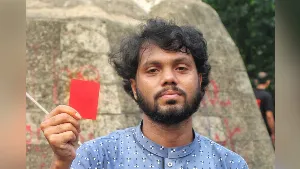
AI Summit Protest in Delhi Sparks Political Row in India


A protest by members of the Indian Youth Congress during an international artificial intelligence summit in New Delhi has triggered a political dispute in India, with opposition leaders defending the demonstration and the ruling party condemning it as damaging to the country’s global image.
Fourteen Youth Congress members, including the organisation’s national president Uday Bhanu Chib, were arrested by Delhi Police after staging a protest near the venue of the AI Impact Summit held at Bharat Mandapam in the Indian capital.
Police later detained the protesters and sent them to Tihar Jail, a major prison complex in Delhi. Chib was released on 3 March and subsequently spoke about the reasons behind the protest.
Youth Congress defends protest
According to Chib, the demonstration was intended to draw attention to concerns about an economic agreement with the United States that opposition activists believe could harm domestic interests.
Speaking after his release, Chib said the proposed trade arrangement would negatively affect Indian farmers and national economic priorities.
“The trade deal with the United States was against the interests of the country and farmers,” he said, explaining that Youth Congress members organised the protest to oppose the policy.
The Indian Youth Congress is the youth wing of the Indian National Congress party, the country’s main opposition political organisation.
The protest occurred during the AI Impact Summit, an international gathering where technology experts, policymakers and industry leaders were discussing developments in artificial intelligence and its economic implications.
Criticism from the ruling party
Leaders from India’s governing Bharatiya Janata Party criticised the protest, arguing that the disruption at a global technology event reflected poorly on the country.
Amit Malviya, head of the BJP’s information technology department, criticised Congress leader Rahul Gandhi after a video circulated online appearing to reference the demonstration.
In a message posted on the social media platform X, Malviya said the opposition appeared to celebrate actions that he described as damaging to India’s international reputation.
He wrote that the protest occurred while global specialists were gathered to discuss the future of artificial intelligence, adding that such behaviour was inappropriate at an event of international significance.
Malviya claimed the disruption “embarrassed India on a global platform”, accusing the opposition of endorsing behaviour that undermined the country’s image.
He also referred to historical political examples, including statements by India’s first prime minister Jawaharlal Nehru, in an attempt to contrast past political values with present-day protests.
Debate over political expression
Supporters of the protest argue that demonstrations are a legitimate form of political expression and an important part of democratic participation.
Opposition leaders have frequently criticised government policies through protests both inside and outside Parliament, particularly on issues involving economic policy, trade agreements and agricultural reforms.
The demonstration in Delhi reflects ongoing tensions between the ruling Bharatiya Janata Party and the Congress-led opposition over the direction of India’s economic and political policies.
Authorities have not publicly detailed all charges related to the protest, but police action against demonstrators has become a recurring point of debate in Indian politics.
Context: Technology summit and political tensions
The AI Impact Summit in New Delhi was intended to highlight India’s ambitions in artificial intelligence and emerging technologies.
India has increasingly positioned itself as a global hub for digital innovation, hosting international conferences and seeking investment in sectors such as artificial intelligence, data infrastructure and advanced computing.
The presence of international participants at the summit added significance to the event, which government officials have promoted as part of the country’s broader technology strategy.
However, the protest by Youth Congress activists brought domestic political disagreements into the spotlight during the gathering.
Analysts say the incident illustrates how domestic political debates can intersect with international events hosted in the country.
While the immediate controversy centres on the protest and the arrests that followed, it also reflects deeper disagreements between political parties over economic policy, governance and the boundaries of political dissent in India.
India Regulates Natural Gas Supply as Middle East Conflict Disrupts Energy Routes
India Eases FDI Rules for China and Bordering Countries
Om Birla Removal Motion Sparks Heated Debate in Lok Sabha
India Evacuates 67,000 From Gulf as Conflict Raises Security Risks