US President Trump Threatens New Tariffs on Indian Rice Imports


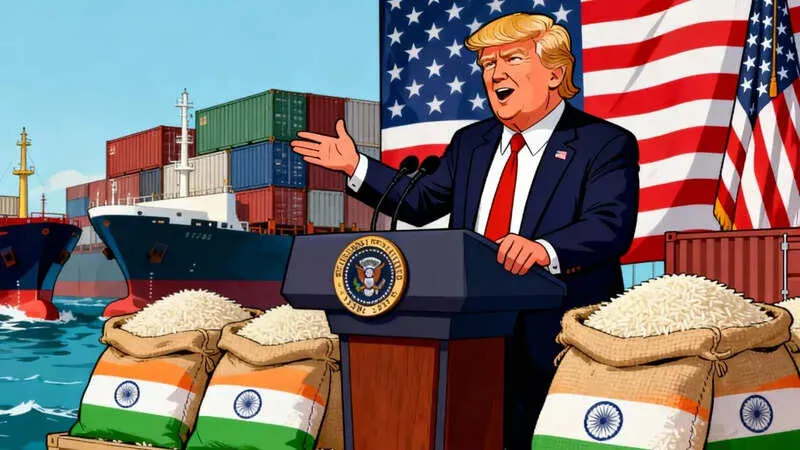
US President Donald Trump has indicated that his administration may introduce additional tariffs on rice imported from India, claiming the country should not be 'dumping' its rice into the American market. During a recent roundtable discussion at the White House, which included officials from the agriculture sector and Treasury, Trump asserted that tariffs could be used to address what he perceives as unfair trade practices.
The Trump administration has already established a steep 50% tariff on a range of Indian goods, marking one of the highest tariffs imposed by the United States on any country. This latest warning regarding rice follows discussions about an ongoing case at the World Trade Organisation concerning India's trade policies.
Trump questioned Treasury Secretary Scott Bessent about India's trade practices, specifically asking, 'Why is India allowed to do that? They have to pay tariffs. Do they have an exemption on rice?' Bessent confirmed that negotiations for a trade deal were still in progress, to which Trump responded, 'But they shouldn't be dumping. I mean, I heard that from others. They can't do that.'
According to Ajay Srivastava, founder of Global Trade Research Initiative, Trump's threats appear to be more politically motivated rather than grounded in trade logic. He noted that while India exported approximately $392 million worth of rice to the United States in the financial year 2025, this figure constitutes merely 3% of India's total rice exports, and the majority of these exports are premium basmati rice.
Experts suggest that any new tariffs would likely have minimal impact on Indian exporters, who have a well-diversified market presence beyond the United States. However, the consequences would be felt more by American consumers, who would face increased prices for rice. Srivastava remarked, 'India should interpret this as election-season messaging to US farmers—not a serious policy shift—and avoid making concessions that could harm US consumers more than Indian producers.'
The Indian Rice Exporters Federation has responded to Trump's remarks, clarifying the dynamics of Indo-US rice trade. Dev Garg, Vice President of the Federation, stated, 'The Indian rice export industry is resilient and globally competitive. While the US is an important destination, India's rice exports are well-diversified across global markets.'
In the financial year 2024-2025, India exported Basmati rice worth $337.1 million to the United States, which translates to 274,213.14 metric tonnes. This positions the US as the fourth-largest market for Indian Basmati rice. During the same period, non-Basmati rice exports were valued at $54.64 million, making the US the 24th largest market for this category.
Indian rice consumption in the US is largely driven by ethnic communities, particularly those from the Gulf and South Asian regions, where dishes like biryani rely heavily on Basmati rice. The Federation noted that Indian rice possesses unique qualities, such as aroma, elongation, and texture, which are not replicated by US-grown varieties.
Prior to the latest tariff adjustment, Indian rice imports faced a 10% tariff, which has now escalated to 50%. Despite this, export levels have remained steady, highlighting the fundamental importance of Indian rice to American consumers. Market analysts observe that the burden of increased tariffs has primarily fallen on US consumers, as evidenced by rising retail prices, while Indian exporters have maintained stable revenue.
In conclusion, while President Trump's warning carries significant weight, the impact on Indian rice exports appears limited, with US consumers likely to face the brunt of any increased tariffs. The ongoing discussions regarding trade agreements between the two nations may shape the future of this trade relationship.

Ceasefire Agreed in Oleshky Amid Ukraine's Humanitarian Crisis
Donald Trump Hints at US Interest in Cuba After Conflict in Iran
UK Court Rules Against India in RAKIA Investment Dispute

India Raises Concerns Over Chinese Border Patrolling Deviations