Tensions Rise Over Strait of Hormuz Amid US-Iran Economic Conflict


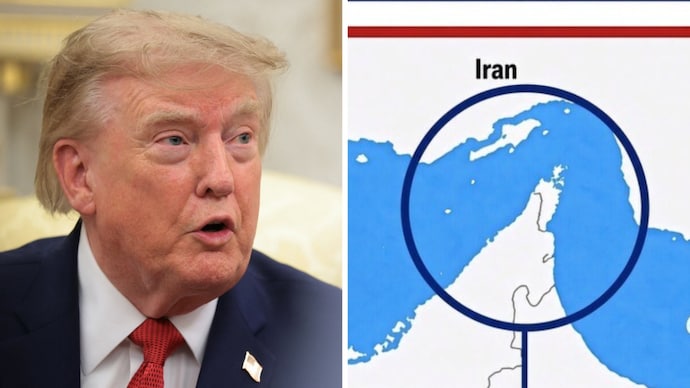
Relations between the United States and Iran have escalated sharply following remarks by US President Donald Trump regarding the strategically crucial Strait of Hormuz. On Sunday, Trump shared an image on his social media platform, Truth Social, labelling the waterway as 'NEW US Territory.' This declaration follows Trump's earlier statements in which he indicated an intention to claim the strait for the United States.
In a police academy address on August 14, Trump proclaimed, 'Pretty soon I’ll be declaring the Strait of Hormuz a territory of the United States.' Iran's Supreme National Security Council secretary, Mohsen Rezaei, quickly countered this assertion, criticising the US for its claims and stating, 'The gap between America’s inability to reopen the Strait of Hormuz and its claim to own it is greater than the 7,000-mile distance between Washington and the Strait itself.' He described the situation as part of a 'post-American order in the Persian Gulf.'
The rhetoric is intensifying as Washington prepares to impose further sanctions on Iran, contributing to an already strained economic relationship. Iran has condemned these anticipated sanctions, asserting that they could exacerbate its economic challenges and impact major trading partners, especially China, which continues to be a significant buyer of Iranian oil. US Treasury Secretary Scott Bessent is set to announce what he describes as 'the toughest sanctions in history' against Iran and has urged China to collaborate with the US concerning Tehran’s oil exports.
Esmaeil Baghaei, spokesperson for the Iranian Foreign Ministry, derided the planned sanctions as an extension of US authority beyond its borders, declaring, 'Such secondary sanctions find no foundation in international law.' Rezaei further emphasised that neighbouring countries should refrain from aligning with the US economic initiatives: 'We are telling all nearby countries not to join the US economic war; otherwise, we will consider them as enemies.'
The Strait of Hormuz has become a significant point of contention as Iran maintains it remains closed, threatening to act against any unauthorised oil tankers. This situation is hampering global energy shipments, with only a few commodity vessels managing to navigate the strait, while most crude carriers and liquefied natural gas (LNG) tankers are absent.
Despite the escalating tensions, Iran has allowed some Iraqi oil tankers to pass through the strait upon requests from Baghdad. US Energy Secretary Chris Wright stated that the US military has facilitated the movement of an average of 8 million barrels of oil per day through the waterway recently, a stark contrast to the over 20 million barrels that were transported before the conflict significantly affected operations.
Concerns about Iran's capacity to disrupt tanker traffic persist, as it still possesses considerable missile and drone capabilities despite substantial losses in its military infrastructure. Trump has cautioned countries against offering any assistance to Iran, insisting that Tehran must conform to what the US considers to be an acceptable agreement. Nonetheless, Iran continues to project defiance while indicating a willingness to engage in diplomatic resolutions. Iranian President Masoud Pezeshkian has advocated for dialogue to resolve the ongoing conflict, asserting that Iran should seek to halt the war while maintaining its sovereignty and respect.
With Trump reiterating that the Strait of Hormuz will be treated as 'NEW US Territory' and Iran firmly stating that the strait will remain closed unless there are changes in Washington’s approach, the strategic waterway continues to be a focal point in the escalating US-Iran conflict.
Kerala Initiates Probe into 2006 Suicide Case Involving CEC
Extradition of Sheikh Hasina Feasible, Says Indian High Commissioner

Punjabi Makeup Artist Mad Sandhu Shot Dead in Amritsar

India Achieves Fourth Place at Asian Games 2026 Through Late Success