Tamil Nadu Assembly Election: ECI Reviews Preparedness


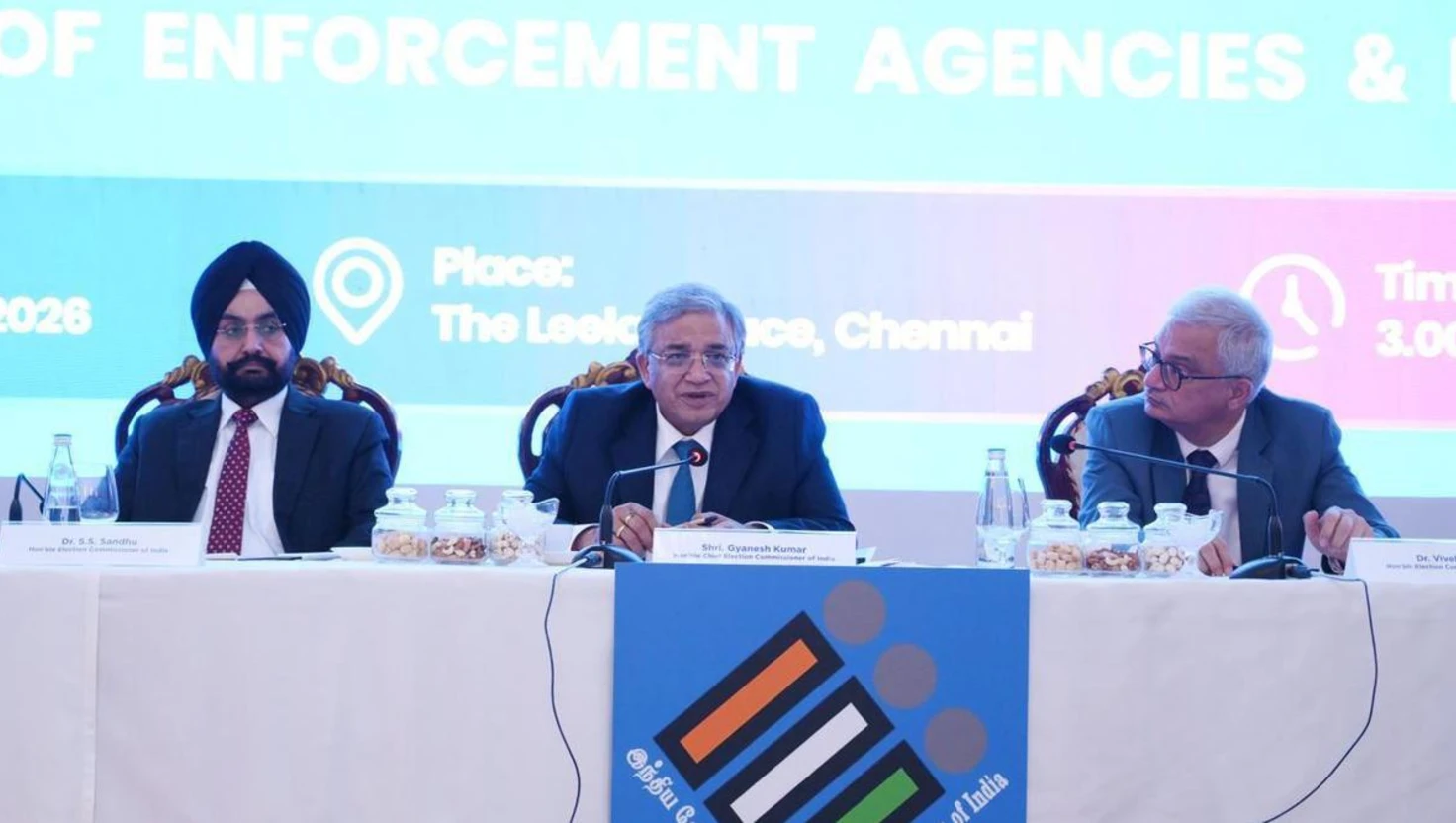
India’s Election Commission has reviewed preparations for the forthcoming Tamil Nadu Assembly election, meeting political parties and senior officials in Chennai to assess readiness and address concerns.
Chief Election Commissioner Gyanesh Kumar, accompanied by Election Commissioners Sukhbir Singh Sandhu and Vivek Joshi, held consultations on Thursday with representatives of recognised national and state political parties, according to an official statement.
Consultations With Political Parties
Representatives from major parties including the Dravida Munnetra Kazhagam (DMK), the All India Anna Dravida Munnetra Kazhagam (AIADMK), the Indian National Congress, the Bharatiya Janata Party (BJP), the Communist Party of India (Marxist), and several regional groups attended the meeting.
Most parties, the Commission said, appreciated the conduct of the recent Special Intensive Revision of electoral rolls, an exercise aimed at updating and verifying voter lists.
However, political parties urged the Commission to take stricter steps to prevent the use of money and inducements during the campaign. Some suggested increasing the number of flying squads tasked with monitoring electoral malpractice.
Several parties also requested that major religious and cultural festivals be considered when finalising the polling schedule.
The Communist Party of India (Marxist) formally sought a single-phase election in Tamil Nadu. Chief Election Commissioner Gyanesh Kumar later told reporters that a decision on the number of phases would be taken after considering all relevant factors. The final determination will be made when the election schedule is announced.
Concerns Over Electoral Rolls and Voting Process
In written submissions, leaders from the DMK raised concerns about the publication of age-related data in the final electoral rolls and alleged that some district officials were reluctant to share detailed information. They also said that outdated voter identity card details were still being referenced.
The Communist Party of India (Marxist) proposed changes to the sequencing of voting machines at polling stations and called for new voter identity cards reflecting revised serial numbers. It also requested improved facilities at polling stations, including drinking water and other amenities for voters.
Responding to these representations, Mr Kumar assured parties that their suggestions would be examined.
The Chief Election Commissioner described the recently concluded revision of electoral rolls as a “model for the country” and said it ensured cleaner voter lists. Addressing criticism that the exercise had resulted in large-scale deletion of names, he said it demonstrated the professionalism of election officials.
Election Administration and Enforcement
The Commission also met enforcement agencies, police officials, district election officers and other administrative personnel to review operational aspects of the poll.
Discussions covered electronic voting machine management, logistics, training of election staff, law and order arrangements, voter awareness initiatives and measures to prevent illegal inducements.
According to the official release, the Commission directed enforcement agencies to act impartially and take firm action against attempts to influence voters. District officials were instructed to prioritise voter comfort and accessibility at polling stations and to ensure proper training of personnel.
The Commission emphasised that there would be “zero tolerance” for violations of election rules and that officers must act without fear or favour.
Mr Kumar said that Tamil Nadu’s election machinery had assured him the forthcoming Assembly poll would set new standards. Referring to recent elections in Bihar, he said Tamil Nadu was expected to surpass them in terms of smooth conduct and organisation.
He also confirmed that mandatory verification of a sample of votes using Voter Verifiable Paper Audit Trail (VVPAT) slips would take place. Candidates may request further verification within seven days of counting by paying a prescribed fee.
As part of new procedures, postal ballots will be counted before electronic voting machine rounds, two rounds in advance.
Rajya Sabha Election Notification
Separately, the Election Commission has issued the notification for biennial elections to six seats from Tamil Nadu in the Rajya Sabha, the upper house of India’s Parliament.
The terms of the six sitting members are due to expire on 2 April. According to the notification, nominations must be filed by 5 March, with scrutiny scheduled for 6 March and withdrawal permitted until 9 March.
If required, polling will be held on 16 March at the Secretariat in Chennai.
Broader Context
Tamil Nadu, one of India’s most politically active states, has long been dominated by regional parties such as the DMK and the AIADMK. Voter turnout in the state has historically been high.
Mr Kumar described the state’s democratic traditions as “glorious” and referred to the ancient “Kudavolai” system, a historical method of local governance selection, as an example of its long-standing electoral heritage.
The Assembly election, expected later this year, will determine the composition of the 234-member Tamil Nadu Legislative Assembly. The final election schedule, including dates and phases, is anticipated in the coming weeks.
Kerala Initiates Probe into 2006 Suicide Case Involving CEC

Extradition of Sheikh Hasina Feasible, Says Indian High Commissioner

Punjabi Makeup Artist Mad Sandhu Shot Dead in Amritsar

India Achieves Fourth Place at Asian Games 2026 Through Late Success