Severe Smog Engulfs Delhi as Air Quality Index Reaches Alarming Levels


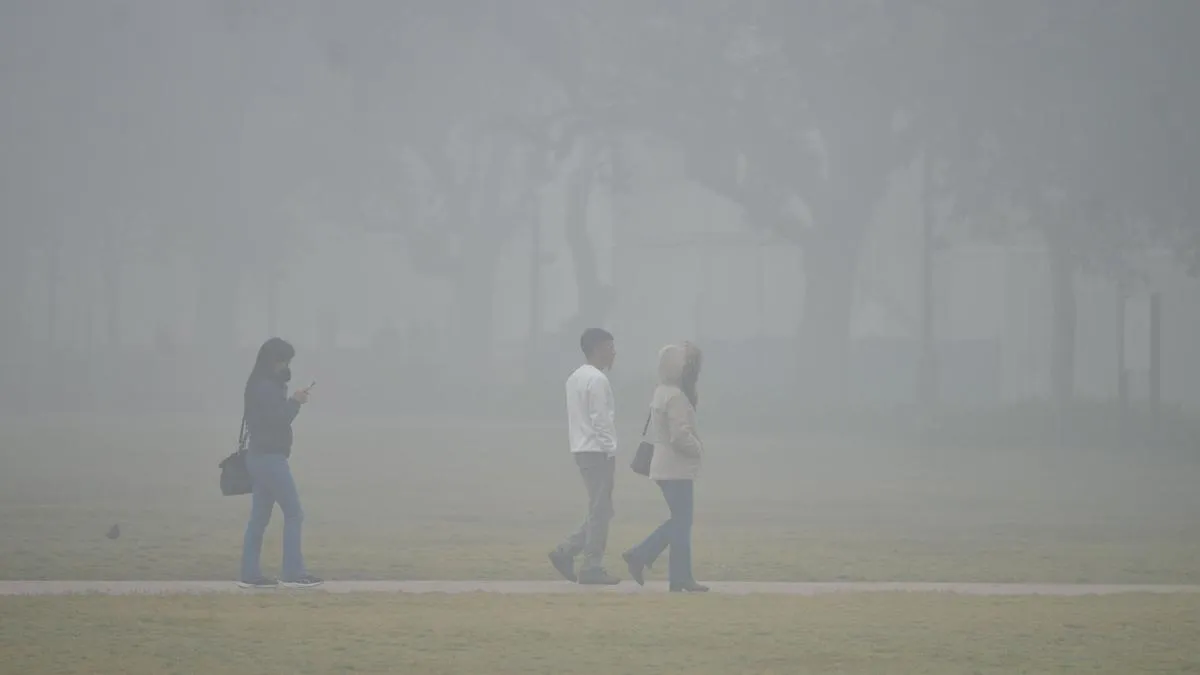
NEW DELHI: A thick layer of smog has enveloped significant areas of Delhi and the National Capital Region (NCR), resulting in alarming levels of air pollution. On Sunday, real-time data from the Central Pollution Control Board (CPCB) indicated that the Air Quality Index (AQI) reached 'very poor' to 'severe' levels across various monitoring stations.
Key locations such as India Gate and Kartavya Path recorded an AQI of 381, while Anand Vihar and Ghazipur reported even higher levels at 438. The ITO area noted an AQI of 405, indicating a serious decline in air quality. According to the AQI scale, scores between 301 and 400 are classified as 'very poor', while 401 to 500 are classified as 'severe'.
Footage from prominent areas such as India Gate and ITO captured the dense grey smog, severely limiting visibility. The haze extended across major thoroughfares, including those near Kartavya Path. In response to the deteriorating air quality, the Commission for Air Quality Management (CAQM) has enacted all measures under Stage-IV of the Graded Response Action Plan (GRAP), a framework designed to combat severe pollution episodes.
As reported by the Press Trust of India (PTI), numerous flights and train services faced delays due to low visibility caused by the fog.
IMD Issues Warning
The India Meteorological Department (IMD) has issued an orange alert for parts of Delhi, signalling the likelihood of dense to very dense fog and cold weather conditions. Meteorologist RK Jenamani explained that the lack of wind has failed to disperse the fog, resulting in low temperatures. "Similar conditions were observed in December 2019 when temperatures dropped significantly on December 17 and 18," he stated.
Visibility is expected to be particularly low during early morning hours, with maximum temperatures forecasted to remain between 16°C and 18°C. The IMD categorises visibility levels as follows: 'very dense fog' when visibility is below 50 metres, 'dense fog' between 50 and 200 metres, and 'moderate fog' when visibility is between 200 and 500 metres. On Saturday, minimum temperatures fell to 6.1°C, two degrees below the seasonal average, with nighttime temperatures expected to hover between 7°C and 9°C.
IndiGo Airlines, one of India's major carriers, issued an advisory regarding flight operations. The airline warned that early-morning fog could drastically reduce visibility, affecting schedules. "We understand that waiting is never easy, and we truly appreciate your patience through these seasonal disruptions," the airline stated. They encouraged passengers to check flight statuses before heading to the airport.
Flight Disruptions
On Saturday alone, over 500 flights faced delays, and 138 were cancelled at Delhi Airport as low-visibility procedures were implemented. The airport reported that the season's first 'cold day' occurred, with maximum temperatures dropping significantly. Safdarjung recorded a maximum of 16.9°C, five degrees below normal, while Palam logged 16.3°C. Visibility at Safdarjung fell to 200 metres from 3 AM and remained poor for nearly ten hours before showing minor improvement.
The northern region has been grappling with dense fog for several days, disrupting air travel. As of December 17, over 800 flights were delayed and 200 cancelled. On December 18, over 700 delays were recorded, including 177 cancellations.
Authorities have advised caution for road travel as visibility remains unpredictable, particularly during the late-night and early-morning hours. Experts have raised concerns about the potential for prolonged periods of dense fog and hazardous smog in the winter months, driven by emissions mixing with stagnant, cold air.
Severe Air Quality Measurements
On the evening of December 21, twelve out of Delhi's forty air quality monitoring stations reported AQI levels exceeding 400, categorising them as 'severe'. The city's average AQI was recorded at 374, indicating 'very poor' air quality. The same data source indicated that the air quality in surrounding cities, such as Noida and Ghaziabad, also fell into 'very poor' categories.
The Air Quality Early Warning System from the Ministry of Earth Sciences has predicted that air quality in Delhi will likely remain in the 'severe' category until Monday, with a slight improvement expected by Tuesday.
As a result of the worsening air quality, Stage IV restrictions under the Graded Response Action Plan have been implemented in Delhi-NCR since December 13. This stage is triggered when AQI levels surpass 450 and includes measures such as a ban on truck entry into the region, suspension of construction activities, and adjustments in school operations.
Delhi is frequently noted as one of the world's most polluted capitals, particularly in winter months, due to factors such as stubble burning in nearby states, vehicular emissions, and industrial pollution. These issues, compounded by low temperatures and stagnant air, contribute to the city's persistent air quality challenges.

Impact of Trump's Tariff Law on India's Oil Imports and Trade

United Russia Party Secures Supermajority Despite Ukraine Conflict

Xi Jinping's US Visit Planned Amid Economic Tensions with Trump

India's External Affairs Minister to Address UNGA Amid US Tariff Changes