Serbia's Student Movement Calls for Resignations of Officials


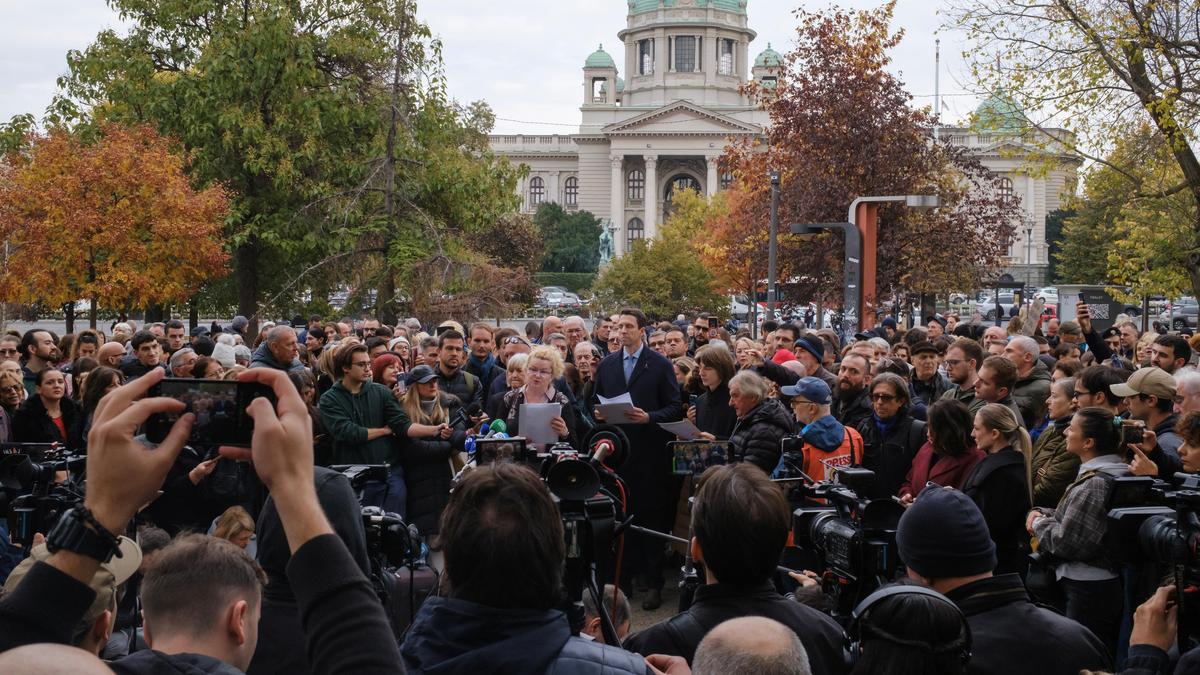
The newly elected student-led coalition in Serbia has called for the resignation of senior officials in the police and judiciary, marking a significant shift in the country’s political landscape. This announcement comes just days after the Student List achieved a surprising victory in the recent elections, unseating the party of former President Aleksandar Vučić.
Standing in Pioneers' Park, located opposite the Serbian parliament, members of the Student List urged the immediate dismissal of police leaders and the heads of various security agencies, identifying violations of the law by some officers. The coalition, composed primarily of students, intellectuals, and professionals, aims to address widespread corruption and restore public faith in governance.
The momentum of the student movement can be traced back to protests ignited by a tragic incident in November 2024, when a canopy collapse at a railway station resulted in the death of 16 individuals. This tragedy underscored the public's frustrations with corruption and mismanagement. The students’ protests were initially met with indifference from the media and authorities, but their resolve turned the tide, culminating in electoral success.
The political dynamics in Serbia shifted dramatically as the students embraced a novel approach to politics, separate from the traditional political parties. Members of the new coalition include professors, athletes, and as many as 12 medical doctors. Their process was marked by transparency and inclusivity, contrasting sharply with the actions of established politicians.
Marija Milovanović, a prominent member of the Student List, reflected on the transformative period, stating, "This is just the first wave of spring cleaning… we are very excited but ready to do it too."
The movement has promised significant reforms under their ‘Student Plan’, pledging to halt corruption, revert stolen assets back to the state, and prioritise investment in education and the economy. Early signs of this shift are already visible, with the resignation of the director of the state broadcaster, Manja Grčić, and the intention to replace the head of Telekom Srbija, Vladimir Lučić.
While the atmosphere is charged with optimism, challenges remain. Dejan Šoškić, a newly elected MP and former central bank governor, highlighted the need for reforms, stressing, "In the first six months, I would like to see the media scene liberated and genuine fight against corruption."
As Serbia forges ahead under this new leadership, the government faces the complex task of balancing domestic reforms with international relations. Serbia’s aspiration to join the European Union coexists with strong ties to Russia, complicating its foreign policy landscape. Despite this, the student-led coalition has not indicated a drastic shift away from their current positions on international partnerships.
The European Union has welcomed the election results, offering support for the new government’s plans aimed at enhancing democratic processes and governance. However, the students' manifesto suggests EU integration is not their immediate priority; they refer to the EU mostly as Serbia's “most important economic partner.”
Currently, the newly formed government is gearing up for the next electoral cycle, with presidential elections approaching in December. The political environment remains fluid as the students, defined by their collective leadership style, prepare to navigate the intricate challenges ahead.

Alert Issued in India Following Lake Outburst in Bhutan
Israeli Election Results Revealed: No Party Achieves Majority

Disha Patani Launches Clothing Brand DZ with Space-Inspired Designs

Brisbane Heat Women Face Sydney Sixers Women in WBBL 2026 Clash