North Korea Advances in Development of Nuclear-Powered Submarine


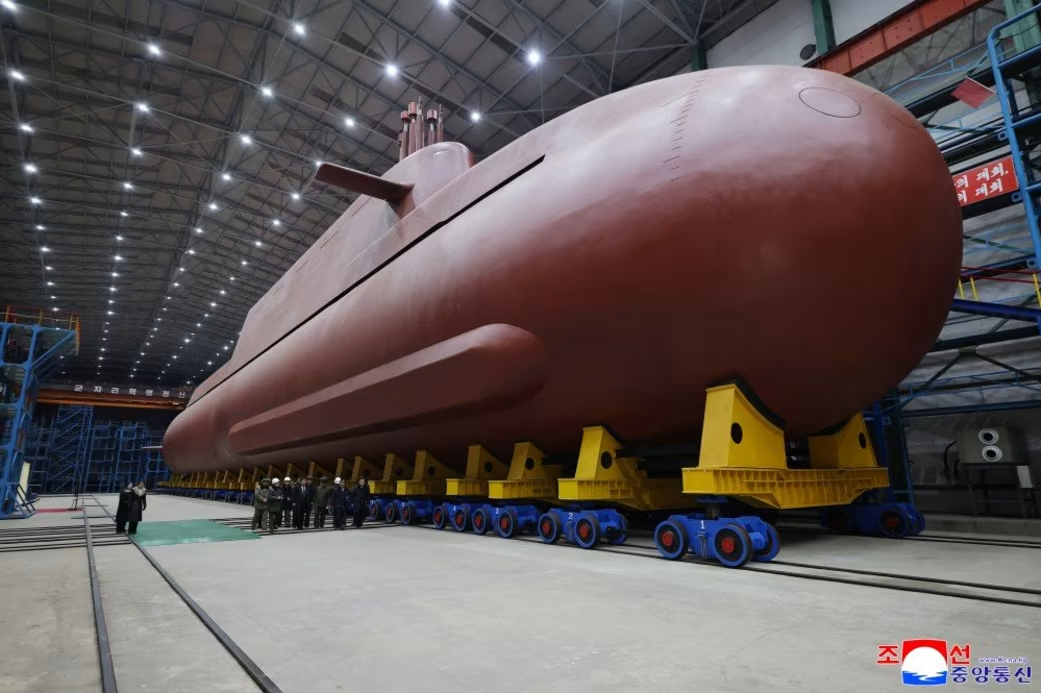
North Korea has released images depicting what appears to be a nearly finished hull of a nuclear-powered submarine, as reported by the Korean Central News Agency. This announcement comes amid heightened tensions surrounding South Korea's ambitions to develop similar naval capabilities.
The photographs feature a large, burgundy vessel under construction, reportedly equipped with anti-corrosion paint, which was inspected by North Korean leader Kim Jong-un, alongside senior officials and his daughter. The state media did not disclose the date of Kim's visit to the shipyard, where the submarine, described as an 8,700-tonne nuclear-propelled submarine, is being constructed.
This marks the first time since March that North Korean state media has showcased images of the submarine, which previously revealed only lower sections of the vessel. Kim Jong-un condemned South Korea's pursuit of nuclear-powered submarines, a project that has garnered support from United States President Donald Trump. He characterised these efforts as an "offensive act" that threatens North Korea's national security and maritime sovereignty.
Kim's remarks highlighted the necessity for North Korea's military to modernise, stating that the completion of its nuclear-powered submarine would represent a significant advancement in bolstering the country’s nuclear deterrent capabilities.
The submarine is expected to be outfitted with nuclear weapons and is referred to as a "strategic guided missile submarine" or a "strategic nuclear attack submarine." According to Moon Keun-sik, a submarine expert at Hanyang University in Seoul, the release of images showcasing a nearly complete hull suggests that many essential components, including the engine and possibly the reactor, are already installed. Moon, a former officer in the South Korean navy, noted, "Showing the entire vessel now seems to indicate that most of the equipment has already been installed and it is just about ready to be launched into the water."
Experts believe that the North Korean submarine could potentially be tested at sea within months, marking a significant milestone in the country's military capabilities. The development of a nuclear-powered submarine is part of a broader agenda announced by Kim during a political conference in 2021, which included advanced weaponry such as solid-fuelled intercontinental ballistic missiles and hypersonic weapons.
The potential for a submarine that can operate undetected for extended periods and launch missiles from beneath the surface presents a significant concern for North Korea's neighbours, as such capabilities would complicate early detection of missile launches.
Despite stringent international sanctions on North Korea, questions remain about the country's ability to acquire the necessary resources and technology for constructing nuclear-powered submarines. Some analysts speculate that North Korea's alliance with Russia, which has included military support for President Vladimir Putin's actions in Ukraine, may have facilitated access to advanced technologies.
Although there are suspicions that North Korea might have sought a reactor from retired Russian submarines, Moon suggests it is more plausible that the nation is developing its own reactor, possibly with some technological guidance from Russia.
In a recent summit, South Korean President Lee Jae Myung sought US backing for South Korea's own nuclear-powered submarine programme, reinforcing a commitment to increase defence spending. Trump indicated that the US would be willing to share advanced technology to assist South Korea in developing a nuclear-powered submarine, but details regarding the timeline and means of acquiring the necessary nuclear fuel and reactor technology remain unclear.
On a separate note, the Korean Central News Agency reported that Kim supervised tests of new anti-air missiles launched into the sea. South Korea's Joint Chiefs of Staff confirmed that several missiles were detected being launched from a coastal area in the east of North Korea.
Tensions on the Korean peninsula have escalated in recent years as Kim Jong-un has intensified his nuclear programme and strengthened ties with Moscow following Russia's full-scale invasion of Ukraine in early 2022. The North Korean government continues to dismiss calls from Washington and Seoul to resume negotiations aimed at curtailing its nuclear and missile programmes, which have stalled since a failed summit with Trump in 2019.
Kerala Initiates Probe into 2006 Suicide Case Involving CEC
Extradition of Sheikh Hasina Feasible, Says Indian High Commissioner

Punjabi Makeup Artist Mad Sandhu Shot Dead in Amritsar

India Achieves Fourth Place at Asian Games 2026 Through Late Success