Marine Le Pen Launches Presidential Campaign Amid Protests


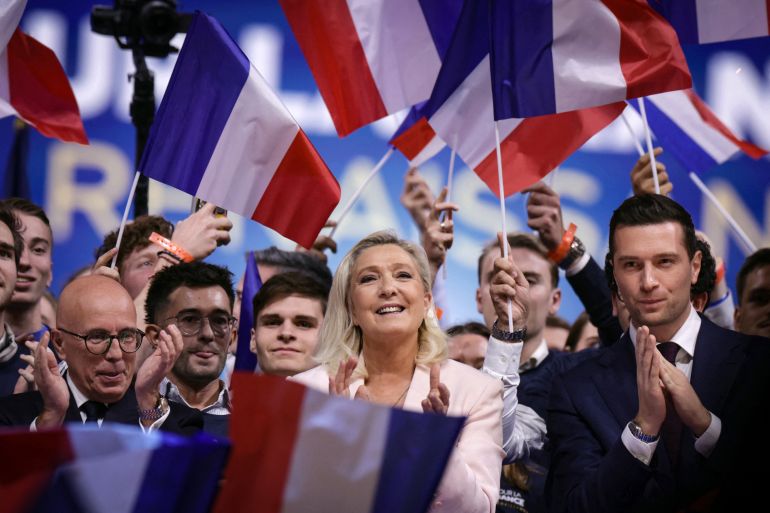
Marine Le Pen, leader of the National Rally party, has launched her presidential campaign in Orleans, France, promising a 'renaissance' for the nation amid ongoing protests and widespread social and economic dissatisfaction. Speaking to approximately 8,500 supporters, she emphasised her commitment to restoring French authority and security. The gathering was met with fervent cheers, showcasing her rising popularity in the polls. Le Pen's campaign gains momentum as she frames the upcoming election as a pivotal moment for France, which she describes as being in a state of crisis.
Her remarks were filled with assurances of a return to normalcy and the enforcement of law and order. 'We are going to re-establish the rule of law,' she stated, earning loud applause from the crowd donned in 'Marine présidente' merchandise. Supporters expressed their enthusiasm, citing the party's values as resonant with their beliefs.
The backdrop of her campaign coincides with large-scale protests that erupted in mid-September, initially sparked by high school students in a Paris suburb. This movement has since escalated into a national demonstration against rising discontent. The recent protests have seen significant unrest, including instances of violence and looting, with more than 2,000 arrests reported on October 17 alone.
As tensions escalated across the country, Marine Le Pen's National Rally has strategically positioned itself as the proponent of law and order, critiquing President Emmanuel Macron's handling of security matters, and accusing opposition leaders of inciting unrest.
Le Pen gathered in Orleans, a city historically associated with Joan of Arc, a figure who represents French identity and resistance. Her choice of venue holds symbolic importance for the party, which aims to project itself as the custodian of French sovereignty. While the National Rally has shifted its approach in recent years, moving away from more extreme views, it continues to grapple with its historical associations with xenophobia and anti-Semitism.
Through a method known as 'dédiabolisation' or de-demonisation, the party has sought to expand its base among various social groups, including young urbanites and middle-class voters who previously leaned towards centrist parties. Le Pen has mixed calls for strict immigration controls with pledges for social reforms, appealing to the working-class electorate by advocating for public services and economic welfare.
While the party has distanced itself from radical proposals like leaving the Eurozone, the possibility of a Eurosceptic leader at the head of one of the largest economies in the European Union could have significant implications. Le Pen has also promised a referendum on restricting EU influence over migration policies, alongside a considerable reduction in France’s contributions to the EU budget. As she builds her case for the upcoming elections, the political landscape in France continues to evolve in the face of civic unrest and shifting allegiances.

Gold and Silver Prices Decline Amid Rising Oil Prices

Madhoo Supports Rashmika Mandanna's Embrace of Her Accent

Shadab Khan Leads Pakistan to Thrilling Comeback Against England

Kylian Mbappe Guides Real Madrid to El Clasico Victory Over Barcelona