India Responds to Joint Pakistan-China Statement on Kashmir


India's Ministry of External Affairs has issued a strong response to a recent joint statement from China and Pakistan that references Jammu and Kashmir. MEA spokesperson Randhir Jaiswal stated on Tuesday, “India's position is consistent and well-known to the concerned parties. The Union Territories of Jammu and Kashmir and Ladakh have been, are and will always remain integral and inalienable parts of India.”
Jaiswal continued, asserting that no other nation has the right to comment on India's territorial claims. He specifically addressed the China-Pakistan Economic Corridor (CPEC), describing it as illegal because it involves regions that India claims as its own. He made it clear that India “resolutely oppose[s] and reject[s] any moves by other countries to reinforce or legitimise Pakistan's illegal and forcible occupation of these territories.”
The MEA has previously conveyed its views on this matter to both Pakistani and Chinese officials. Jaiswal also criticised references made in the joint statement about 'trans-boundary water resources cooperation', emphasising that some projects are situated within India’s sovereign territory. He stated, “The two countries do not share any boundary, the question of so-called 'trans-boundary water resources cooperation' does not arise.” Additionally, India has not recognised the boundary agreement made between Pakistan and China in 1963.
This joint statement has raised concerns as it suggests that Beijing may be attempting to leverage the Kashmir issue alongside water resources discussions to support Pakistan. The joint communiqué also reiterated Pakistan's commitment to the “One China Policy”, which asserts that Taiwan is part of China. Such statements are typical in high-level diplomatic meetings, signalling China's intent to maintain its alliance with Pakistan.
Beijing appears to be encouraging Islamabad to allow Gwadar, a port city in Pakistan, to serve as a strategic naval base for China in the North Arabian Sea. India reiterated its opposition to the CPEC and reminded that Pakistan ceded approximately 5,180 square kilometres of territory in the Shaksgam Valley to China in 1963. This territory is also part of the broader Kashmir dispute.
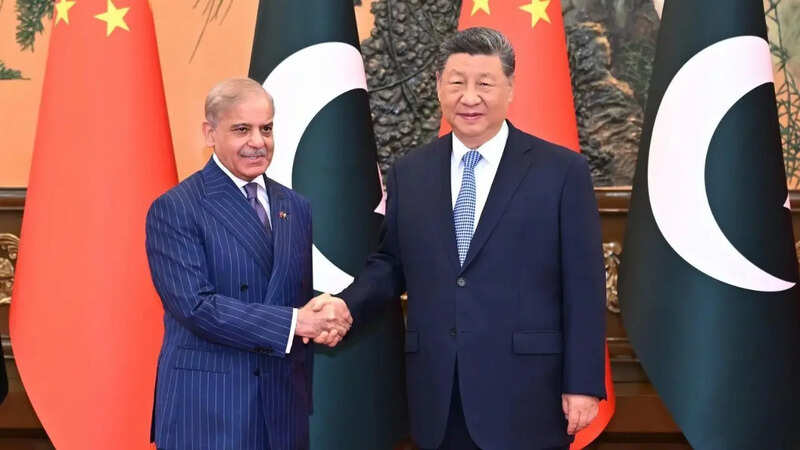
The joint statement was released following Pakistani Prime Minister Shehbaz Sharif’s visit to China from May 23 to 26, during which he met Chinese President Xi Jinping and Premier Li Qiang. The two nations expressed a consensus on enhancing their long-standing strategic partnership. In addition, the Pakistani side briefed their Chinese counterparts on the latest developments regarding Jammu and Kashmir, with China reiterating that the matter should be addressed in accordance with the United Nations Charter.
Despite the usual diplomatic language, the statement's implications underline ongoing tensions in the region, particularly in India's relationship with both Pakistan and China. The focus on militaristic cooperation and infrastructure development in disputed territories raises serious questions about regional stability and sovereignty.
Trump, Putin, and Xi to Meet at APEC Summit in Shenzhen, China
Congress Criticises Adani for Dramatic Cost Cut in Maharashtra Project

Urban Infrastructure Crucial for India's Manufacturing Growth

India Extends Ban on Zakir Naik's Islamic Research Foundation