India and EU Reach Landmark Free Trade Agreement Amid US Tensions


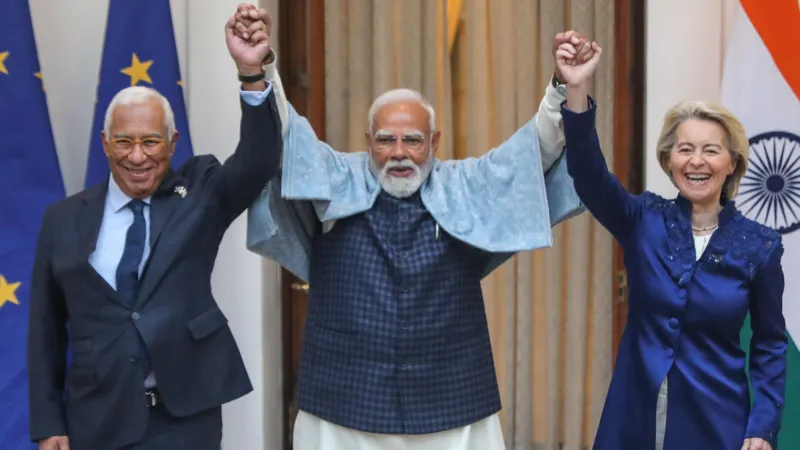
The European Union and India have formalised a significant trade agreement, concluding nearly two decades of negotiations with the intent of strengthening economic ties against a backdrop of rising tensions with the United States. European Commission President Ursula von der Leyen described the deal in Delhi as 'the mother of all deals', while Indian Prime Minister Narendra Modi labelled it 'historic'. This agreement enables free trade between the 27 EU member states and India, the world's most populous nation, which collectively represent about 25% of the global gross domestic product and a market of around two billion consumers.
As part of the agreement, there will be substantial tariff reductions across numerous goods and services, along with the introduction of a joint security partnership. During a bilateral summit in Delhi, von der Leyen, accompanied by European Council President António Costa, met with Modi to discuss the implications of the new deal. The deal will eliminate tariffs on most exports of chemicals, machinery, and electrical equipment, in addition to aircraft and spacecraft, through phased reductions.
A particularly notable aspect involves cutting tariffs on motor vehicles, which currently stand at 110%, down to just 10% under a quota of 250,000 vehicles—significantly larger than the 37,000 unit quota India granted the UK in a previous agreement. In return, India will reduce tariffs on wine, beer, and olive oil imports from the European Union. Brussels has indicated the agreement will enhance investment flows, improve access to European markets, and deepen integration within supply chains.
For Indian exports, nearly all sectors will benefit from preferential access to the EU. Key industries such as textiles, leather, marine products, handicrafts, gems, and jewellery will see tariff reductions or complete eliminations. Items like tea, coffee, spices, and processed foods are also positioned to gain advantages from the agreement. However, some sensitive sectors, including dairy and certain agricultural products, have been safeguarded to balance export growth with national priorities.
Additionally, both parties have agreed to a mobility framework that will relax restrictions on the movement of professionals between India and the EU, thereby facilitating easier travel. 'This is India's biggest free trade agreement,' stated Modi. 'It will facilitate access to European markets for farmers and small businesses and enhance both manufacturing and service sectors.'
The timing of this deal aligns with both India and the EU facing economic and geopolitical pressures from the US. India, in particular, has been negotiating amid the backdrop of high tariffs imposed by former US President Donald Trump last year. Trump previously threatened to increase tariffs on European allies due to various political disputes, illustrating the broader geopolitical landscape impacting trade negotiations.
The sentiment of cooperation was echoed by von der Leyen, who remarked, 'This is the tale of two giants— the second and fourth largest economies in the world—choosing partnership in a win-win situation. It sends a strong message that cooperation is the best response to global challenges.'
António Costa added that the new trade agreement sends a powerful political message that highlights the commitment of both India and the EU to prioritise trade agreements over tariffs.
Experts believe this agreement could significantly benefit labour-intensive sectors in India, including shrimp farming, textiles, and jewellery, which have been adversely affected by US tariffs. Nevertheless, there are warnings about adapting to stringent European regulations, particularly regarding environmental standards, which could pose challenges for Indian manufacturers. Economist Mitali Nikore expressed a view that while challenges exist, the situation should be viewed as an opportunity.
For the EU, this trade agreement is intended to provide economic certainty amidst global volatility. Analysts suggest that countries such as Germany and France will be significant beneficiaries, although the agreement may not fully realise the ambitious potential envisioned at its inception; yet, it is seen as a foundational step for further developing bilateral relations.
The formal signing of this agreement is expected to occur later this year, pending approval from the European Parliament and member states. Concerns remain about the approval process, particularly in light of recent controversies surrounding another EU trade agreement with the Mercosur bloc, which was stalled in the European Parliament. However, the India-EU deal is anticipated to be less contentious as it sidesteps many sensitive issues.
In addition to the trade deal, India and the European Union are progressing discussions on enhanced security and defence cooperation. India's Defence Minister Rajnath Singh has been engaged in discussions regarding potential collaborations on maintaining maritime security, countering cyber threats, and fostering defence dialogue with EU leaders. A draft security partnership is being developed for this purpose.
Currently, the EU stands as India's largest trading partner in goods, with the total volume of bilateral merchandise trade reaching approximately $136 billion (£99.4 billion) as of 2024–2025. Following the initial talks in 2007, negotiations faced multiple interruptions, culminating in a renewed push for agreement in July 2022. Diplomatic insights indicate that Trump's tariffs inadvertently served as a catalyst for finalising the trade deal. Over the past seven months, India has also reached significant trade agreements with the UK, Oman, New Zealand, and others, highlighting its active engagement in expanding international trade relations. The evolving dynamics of global trade will likely continue to shape India's partnerships moving forward.
Union Budget 2026: Key Expectations for Banking and Tax Reforms
Israel Confirms Recovery of Remains of Last Hostage from Gaza
India and EU Finalise Long-Awaited Free Trade Agreement
Rahul Gandhi Faces Criticism for Not Wearing Traditional Patka