IMF Chief Warns of AI's Job Risk While Praising Its Potential


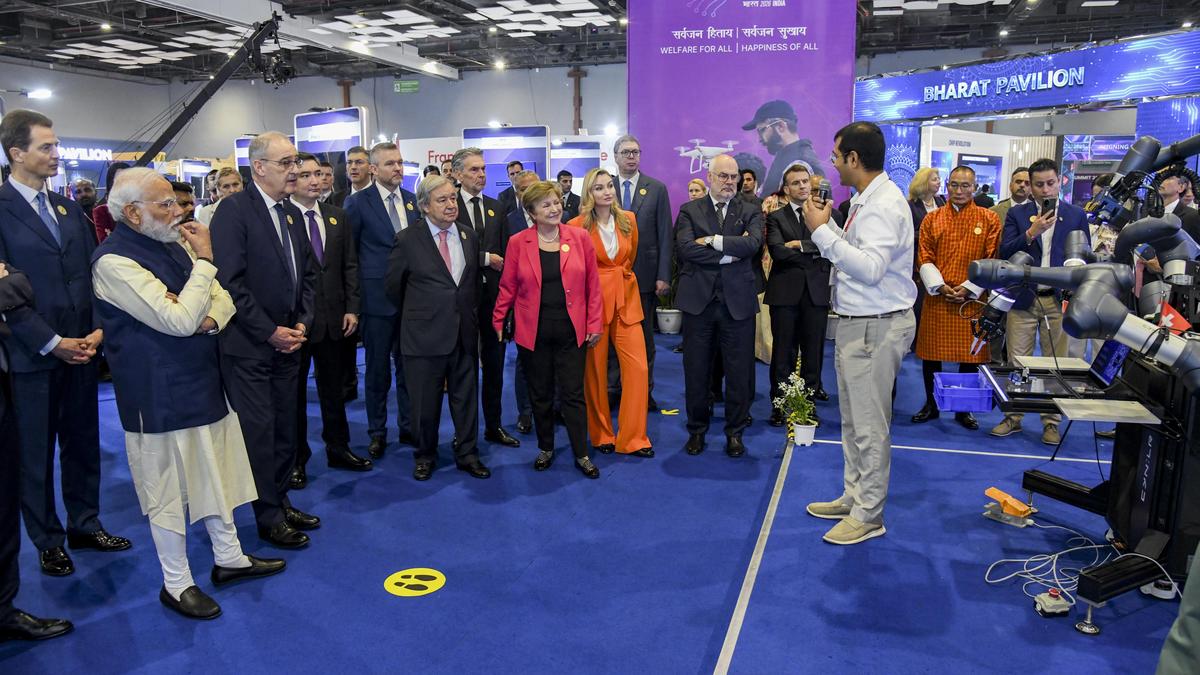
Kristalina Georgieva, the Managing Director of the International Monetary Fund (IMF), addressed the AI Impact Summit held in New Delhi on February 20, 2026, discussing the potential benefits and significant risks of artificial intelligence (AI) for global economies and job markets. She stated that the integration of AI could enhance global economic growth by as much as 0.8%, suggesting that India could achieve its Viksit Bharat goal through effective AI adoption.
Georgieva emphasized the importance of recognising AI as both an opportunity and a challenge. While she expressed optimism about AI's role in propelling economic advancement, she cautioned against underestimating the risks associated with it. 'AI can lift up global growth by almost a percentage point. We say 0.8%. It would mean that the world would grow faster than it did before the COVID pandemic,' she remarked.
During her address, she highlighted three main risks of AI: increasing inequality between nations in terms of technology access, potential threats to financial stability, and job displacement. Georgieva noted that as automation increases, an estimated 40% of jobs globally could be affected, with the impact varying significantly between emerging and advanced economies.
'We actually see the impact of AI on the labour market like a tsunami hitting it. Globally, 40% of jobs will be affected by AI, some enhanced, others eliminated,' she explained. Furthermore, she mentioned that the effects of AI on employment are already being observed in the United States, where many jobs require additional skills due to automation.
Georgieva indicated that while AI might eliminate low-paying entry-level jobs, it could lead to the creation of more skilled positions, contributing positively to overall employment. To adapt to this rapidly changing job landscape, she urged for a revamp of education systems. 'People have to learn to learn, not to learn specific skills so much,' she stated, emphasising the necessity for educational frameworks to support continuous learning.
Additionally, Georgieva called for stronger social protections to assist workers during this transition. She warned that a failure to acknowledge the detrimental impacts of AI on certain communities could parallel the backlash against globalisation, which many experts believe resulted from insufficient consideration of local consequences.
The IMF is monitoring various countries' positions regarding AI adoption. Some nations have a greater demand for AI skills than available supply, while others find themselves with a surplus of skilled individuals without corresponding job opportunities.
Georgieva concluded her address by highlighting the crucial need for an ethical foundation in AI development. She advised that while technical advancements in AI are underway, more focus should be directed towards establishing ethical guidelines that encourage innovation while providing necessary safeguards.
Kerala Initiates Probe into 2006 Suicide Case Involving CEC

Extradition of Sheikh Hasina Feasible, Says Indian High Commissioner

Punjabi Makeup Artist Mad Sandhu Shot Dead in Amritsar

India Achieves Fourth Place at Asian Games 2026 Through Late Success